BrandVerseHQ — Build. Grow. Evolve.
A business card tells people who you are and how to reach you.
Your website should do much more.
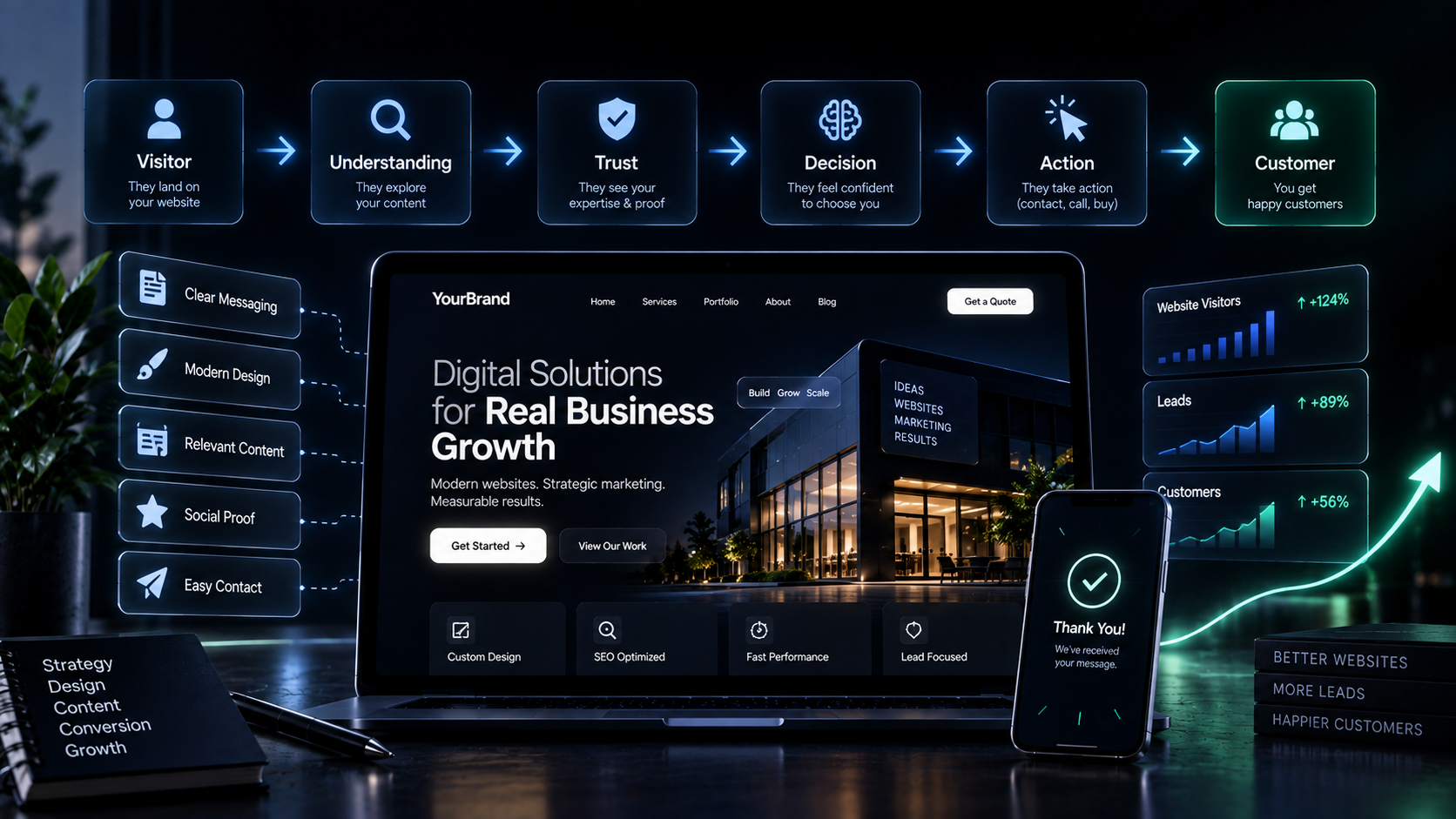
It should help the right people discover your business, understand what you offer, decide whether they can trust you, and take the next step.
That requires more than good visuals.
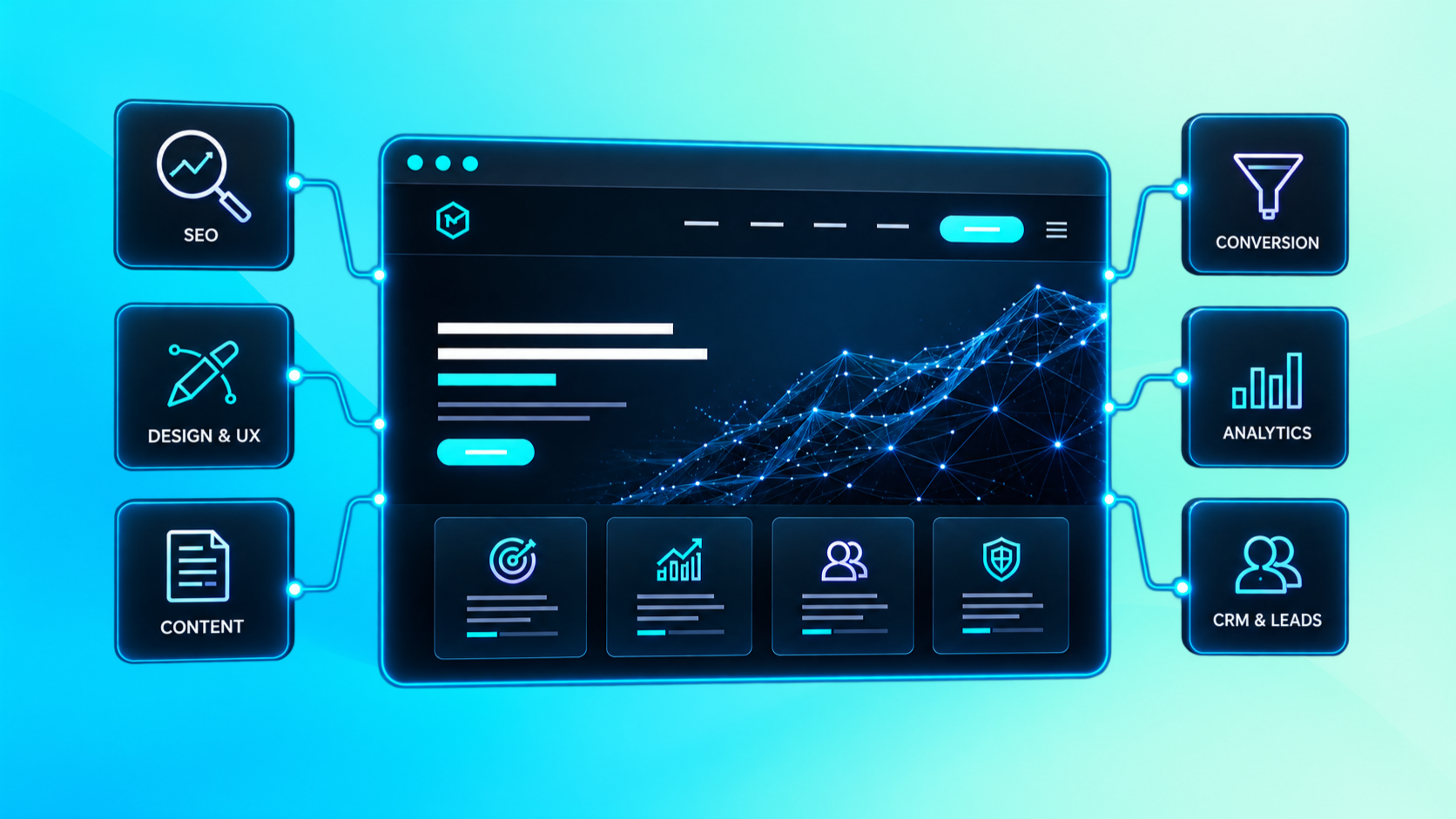
Brand, content, UX, SEO, technology, performance, and conversion need to work together.
Your website isn't simply your digital presence.
It is part of your digital growth system.
The Problem With “We Need a Website”
Many website projects still begin with the same checklist:
Buy a domain.
Add the logo.
List the services.
Add some images.
Create a Contact page.
Launch.
There is nothing inherently wrong with a simple website.
The problem is expecting that website to generate visibility, trust, enquiries, and growth when none of those outcomes were considered during its planning.
A website can look professional and still generate very few leads.
It can attract visitors who are unlikely to become customers.
It can explain what a company does without giving people a compelling reason to choose it.
It can even rank in search and still fail to turn that attention into business value.
The problem usually isn't the website alone.
It's the thinking behind it.
Treat a website as an online brochure and it will largely behave like one.
Treat it as business infrastructure and you can build something far more useful.
Start With the Job Your Website Needs to Do
Before choosing colours, animations, frameworks, or layouts, answer one question:
What should this website accomplish for the business?
“Tell people about our company” is a reasonable starting point, but it is not a complete strategy.
Depending on the business, a website may need to:
Generate qualified enquiries
Explain a complex service
Build credibility
Attract organic search traffic
Support sales conversations
Capture applications
Book appointments
Sell products
Educate potential customers
Move visitors toward a specific decision
Most businesses need several of these outcomes.
The important part is knowing which ones matter most.
Once the objective is clear, it becomes easier to decide what the website should say, how it should be structured, what users should do next, and what should be measured.
A website should have a purpose before it has a layout.
The Website Growth Loop
A useful way to think about a modern website is as a continuous loop:
Discover → Understand → Trust → Engage → Convert → Measure → Improve
Each stage affects the next.
01 — Discover
People may reach your website through Google, social media, referrals, advertising, email, direct visits, content, or AI-powered discovery.
Your website is often where those different journeys come together.
That makes discoverability important.
Search-friendly architecture, useful content, clear page structure, technical quality, and relevant distribution channels all contribute to whether the right audience can find you.
But visibility is only the beginning.
02 — Understand
Once someone arrives, they should quickly understand:
What do you do?
Who do you help?
Why does it matter?
If the visitor has to decode the homepage to answer those questions, the experience is already creating friction.
A sophisticated visual design cannot compensate for unclear communication.
Design earns attention. Clarity earns understanding.
03 — Trust
People rarely make important decisions based only on what a company says about itself.
They look for evidence.
That evidence might include:
Case studies
Testimonials
Reviews
Relevant experience
Client work
Results
Clear processes
Useful content
Transparent information
Strong explanations of what happens next
Trust should not be confined to a single “Testimonials” section.
It should appear throughout the experience.
The service page should reduce uncertainty.
The case study should demonstrate capability.
The process should explain what working together looks like.
The content should demonstrate knowledge.
Trust is built through evidence, not adjectives.
04 — Engage
Understanding and trust should make it easier for visitors to continue their journey.
They may explore a service, compare options, read an article, review a case study, or look for answers to a specific question.
Good UX reduces the effort required to do those things.
Navigation should make sense.
Important information should be easy to find.
Pages should connect naturally.
The visitor should not have to fight the interface to understand the business.
05 — Convert
At some point, the website should make the next meaningful action clear.
That could be:
Requesting a quote
Booking a call
Starting a project
Making a purchase
Downloading a resource
Applying for something
Sending an enquiry
Conversion does not always mean an immediate sale.
A conversion is any meaningful action that moves someone closer to becoming a customer.
The right conversion depends on the business, the visitor, and the stage of the customer journey.
06 — Measure
A website cannot improve intelligently if nobody knows what is happening.
Useful questions include:
Where are visitors coming from?
Which pages attract attention?
Which pages lead to enquiries?
Where do visitors leave?
Which traffic sources produce valuable leads?
Which actions indicate genuine interest?
Measurement turns assumptions into evidence.
07 — Improve
The loop continues after launch.
Businesses change.
Customers change.
Competitors change.
Search behaviour changes.
Technology changes.
The website should change with them.
Sometimes the improvement is a major redesign.
Sometimes it is much smaller:
Rewrite a headline.
Simplify a form.
Improve navigation.
Fix a performance issue.
Strengthen a service page.
Add useful evidence.
Remove unnecessary content.
The goal is not to keep adding. The goal is to keep improving what matters.
Design Alone Doesn't Create Growth
Imagine a website with excellent typography, strong imagery, polished animations, and an impressive visual system.
But the visitor still doesn't understand what the company does.
Or they understand the service but cannot find the next step.
Or they trust the company but the enquiry process is unnecessarily difficult.
Adding more design would not necessarily solve the problem.
The website needs alignment.
Design creates an engaging experience.
UX makes that experience usable.
Content makes the business understandable.
SEO improves discoverability.
Technology provides performance, reliability, and flexibility.
Conversion strategy gives the journey direction.
Measurement shows what is actually happening.
These disciplines support one another.
None can completely replace the others.
A beautiful website can underperform because its messaging is unclear.
A technically excellent website can underperform because its offer is poorly positioned.
A high-traffic website can underperform because visitors have no clear reason to act.
The strongest digital experiences are aligned, not merely polished.
Your Message May Be the Highest-Leverage Improvement
Look at the first meaningful statement on your homepage.
Consider:
“We provide high-quality digital solutions for modern businesses.”
It sounds professional.
But it is difficult to understand what makes the company relevant.
Now consider:
“We build high-performance websites that help businesses turn digital traffic into qualified enquiries.”
The service may be similar.
The difference is communication.
The second statement gives the reader more useful information about the offer and its intended outcome.
Your visitors should not have to translate vague marketing language into something meaningful.
Clarity is part of the product.
SEO Should Start Before the Website Launches
SEO is often treated as something to “do after the website is finished.”
That creates unnecessary limitations.
Website architecture, URL structure, internal linking, heading hierarchy, content organization, performance, indexability, and other technical foundations can all influence search visibility.
They are easier to consider when the website is being planned than when hundreds of pages and links already exist.
This does not mean every website needs an elaborate SEO strategy from day one.
It means search visibility should be considered as part of the foundation.
Search should not be an afterthought.
Your Website Works Beyond Office Hours
A potential customer may discover your business at 11 PM.
Your team may not be available.
Your website can still answer important questions.
It can explain your services, demonstrate your work, communicate your approach, establish credibility, answer common objections, and capture an enquiry.
By the time someone from your team responds, part of the education process may already be complete.
That is one of the most valuable differences between a static brochure and a well-designed digital experience.
Your website can keep working when your team isn't.
Performance Is Part of the Brand Experience
Visitors do not experience your website as code.
They experience it as:
“That loaded quickly.”
Or:
“Why is this taking so long?”
Performance influences usability.
It can also influence how people perceive the business.
A slow or unstable website can create friction before the visitor has even evaluated the actual offer.
That makes performance more than a technical concern.
Performance is part of the customer experience and, therefore, part of the brand experience.
Your Website Should Connect to the Rest of the Business
A website should not become a dead end after someone submits a form.
Depending on the business, it can connect with systems such as:
Analytics
CRM
Booking platforms
Email marketing
Payments
Lead management
Automation
Customer communication
The result is a more connected journey.
A visitor submits an enquiry.
The business receives the information.
The lead enters the appropriate workflow.
The team can follow up.
The interaction can be measured.
The outcome can eventually inform future decisions.
That's when a website starts moving beyond marketing and becomes infrastructure.
Every Piece of Content Should Have a Job
Not every business needs a large blog.
And not every article deserves to exist.
Different types of content can serve different purposes:
Content Potential Job Service pages Capture commercial intent Articles Answer questions and build authority Case studies Demonstrate capability and results FAQs Reduce uncertainty and friction Guides Educate and attract relevant traffic Landing pages Support specific campaigns or audiences
The question should not be:
“Do we have enough content?”
A better question is:
“What is this content helping the visitor or the business accomplish?”
Useful content earns its place.
Don't Measure the Website by Traffic Alone
Traffic is useful.
But traffic by itself does not tell you whether the website is helping the business.
A practical measurement model has three levels:
Acquisition
Where are visitors coming from?
Search, referrals, social media, advertising, direct traffic, email, and other channels.
Engagement
What are visitors doing?
Which pages do they view?
What content do they consume?
Where do they leave?
What paths do they follow?
Conversion
Are visitors taking meaningful actions?
Are they submitting enquiries, booking calls, requesting proposals, purchasing, or completing another valuable action?
But there is a question above all three:
What business value did this traffic create?
That is the level that matters most.
Traffic is a metric. Growth is an outcome.
There Is No Universal Website Formula
A law firm should not necessarily communicate like an e-commerce company.
A healthcare provider has different trust requirements from a SaaS business.
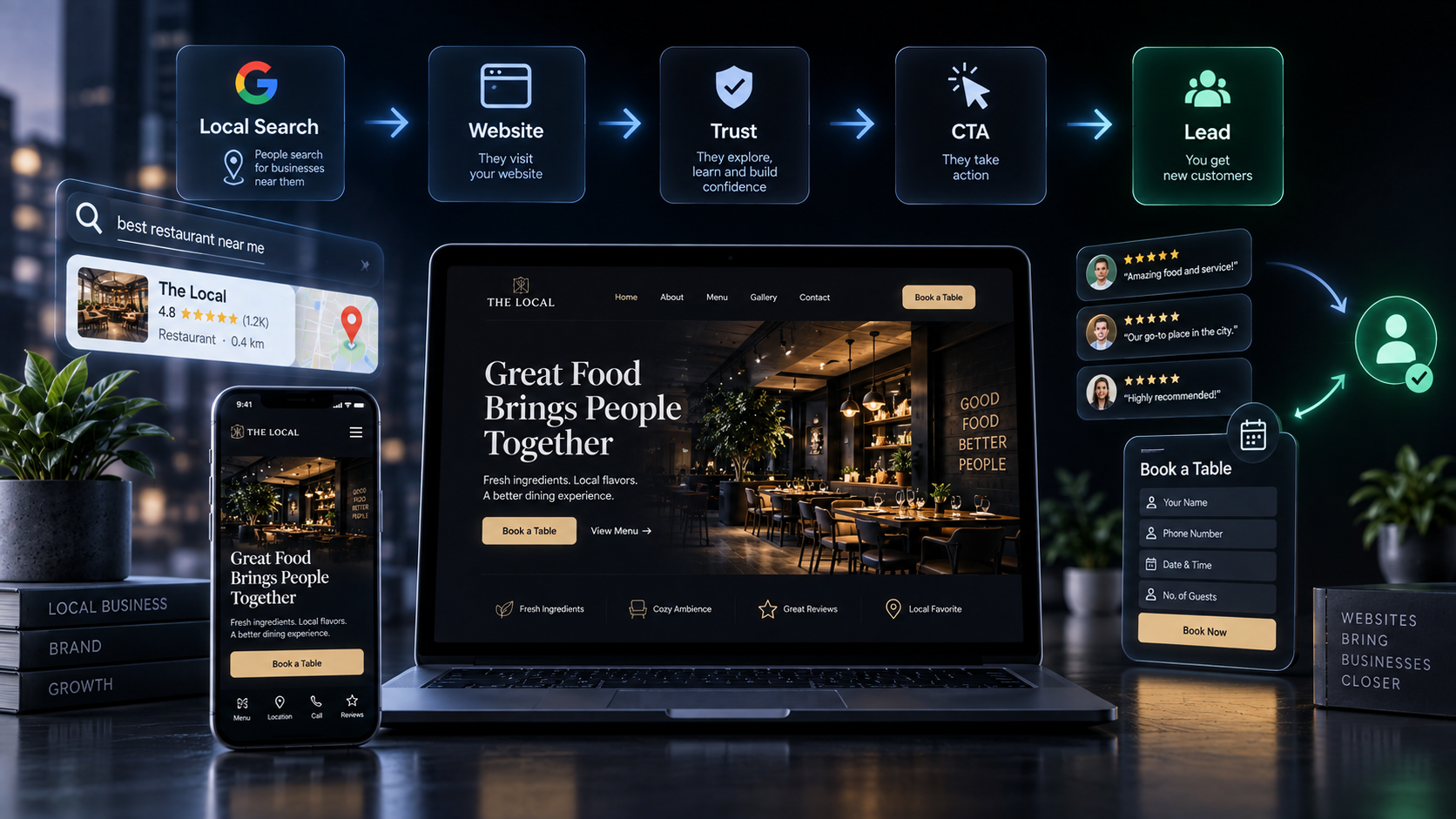
A restaurant does not need the same conversion journey as a B2B consultancy.
The right website starts with the business and its audience.
Ask:
Who is the website for?
What are they trying to accomplish?
What problems or concerns do they have?
What information do they need before taking action?
What evidence will help them trust the business?
What should happen after they take action?
Those answers should influence the site's structure, content, design, technology, and measurement.
Strategy should shape the website, not the other way around.
You Don't Always Need a Complete Redesign
An existing website may already contain valuable foundations.
Before replacing everything, look for what is actually limiting performance.
Audit the fundamentals
Messaging
Can a new visitor understand the offer quickly?
UX
Can people find important information without unnecessary effort?
Conversion
Are the next steps obvious?
Performance
Does the website feel fast and comfortable, especially on mobile?
Search
Can search engines understand and discover the important content?
Trust
Does the website provide enough evidence for someone to feel confident?
Measurement
Can you identify what is working and what is not?
The answer may be a redesign.
But it may also be a better headline, simpler navigation, stronger service content, a shorter form, improved performance, or better measurement.
The smartest digital improvement is not always the biggest one.
A Simple Framework for Evaluating Your Website
If you want to assess your website today, start with these seven questions:
Question What to look for Can people find us? Search visibility and relevant traffic Can they understand us? Clear positioning and messaging Can they trust us? Evidence, experience, reviews, work Can they navigate easily? Clear structure and useful UX Can they take action? Obvious, low-friction conversion paths Can we measure it? Meaningful analytics and conversion data Can we improve it? A process for learning and iteration
If several answers are unclear, the problem may be deeper than visual design.
It may be a strategy problem.
How BrandVerseHQ Thinks About Websites
At BrandVerseHQ, we don't see a website as a collection of pages that simply needs to look good.
We see it at the intersection of:
Business strategy → Brand → Website → UX → Technology → Content → SEO → Marketing → Conversion → Growth
The objective is not to make every website complicated.
Often, the best digital experiences are relatively simple on the surface.
The complexity should live behind the experience so that the visitor gets something clear, fast, intuitive, and purposeful.
That means starting with the business.
What are you trying to achieve?
Who are you trying to reach?
What is currently working?
What is creating friction?
What should improve?
Only then does it make sense to decide what should be designed, developed, optimized, or changed.
The technology matters. The design matters. The thinking behind them matters even more.
Build More Than a Website
Your website may be the first serious interaction someone has with your business.
It should help them:
Discover you.
Understand you.
Trust you.
Engage with you.
Take the next step.
And it should give your business enough insight to keep improving.
When brand, content, UX, SEO, technology, performance, conversion, and measurement work together, the website becomes more than something the business owns.
It becomes something the business uses.
And that distinction matters.
A website that simply exists is a digital asset.
A website that continuously attracts, informs, builds trust, converts, measures, and improves can become part of the company's growth infrastructure.
Can BrandVerseHQ Help?
If you're building a new website, redesigning an existing one, or trying to understand why your current digital presence isn't performing as expected, the first step isn't necessarily another redesign.
It is understanding the problem.
BrandVerseHQ approaches website design and development through the wider context of business objectives, audience, brand, content, UX, technology, search, performance, and growth.
The right solution might be a new website.
It might be a redesign.
It might be better conversion paths, stronger content, improved technical foundations, or a more connected digital strategy.
The solution should follow the problem.
Your business doesn't need a website simply because every business is expected to have one.
It needs a digital presence that works for the business behind it.
[Explore Website Design & Development →]
Frequently Asked Questions
Is a website still important in 2026?
Yes. A modern website can do much more than establish an online presence. It can support brand positioning, search visibility, customer education, lead generation, conversion, analytics, and other digital channels.
What is a digital growth system?
A digital growth system is a connected set of digital experiences, content, technology, and processes designed to help a business attract relevant attention, engage visitors, generate meaningful actions, measure outcomes, and improve over time.
Does a beautiful website guarantee growth?
No. Visual design is only one part of the equation. Messaging, UX, content, SEO, performance, traffic quality, conversion strategy, trust, and the underlying business offer also influence results.
Should SEO be considered during website development?
Yes. Website architecture, content structure, internal linking, performance, indexability, and other technical decisions can affect search visibility. Considering these elements during planning generally creates a stronger foundation.
How often should a website be updated?
There is no universal schedule. A website should evolve when the business, audience, content, technology, search behaviour, or performance data indicates that improvement is needed.
What makes a website high-performing?
A high-performing website combines clear messaging, purposeful design, useful UX, relevant content, technical quality, strong performance, discoverability, trust, clear conversion paths, and meaningful measurement.
Should every business have a blog?
No. A blog is useful when it supports a clear purpose such as answering customer questions, building topical authority, supporting SEO, or helping prospects make decisions. Content should have a job rather than exist simply because other websites have blogs.
Should I redesign my website if it isn't generating leads?
Not necessarily. First identify what is limiting the current website. The problem could be messaging, traffic quality, UX, trust, conversion paths, performance, content, or measurement. An audit can reveal whether a redesign is actually justified.
Final Thought
Your website is often the first serious interaction someone has with your business.
Don't build it simply because your business needs to be online.
Build it because your business is meant to grow.
Your website isn't a business card.
It's a growth system.
Build. Grow. Evolve.
— BrandVerseHQ