BrandVerseHQ — Build. Grow. Evolve.
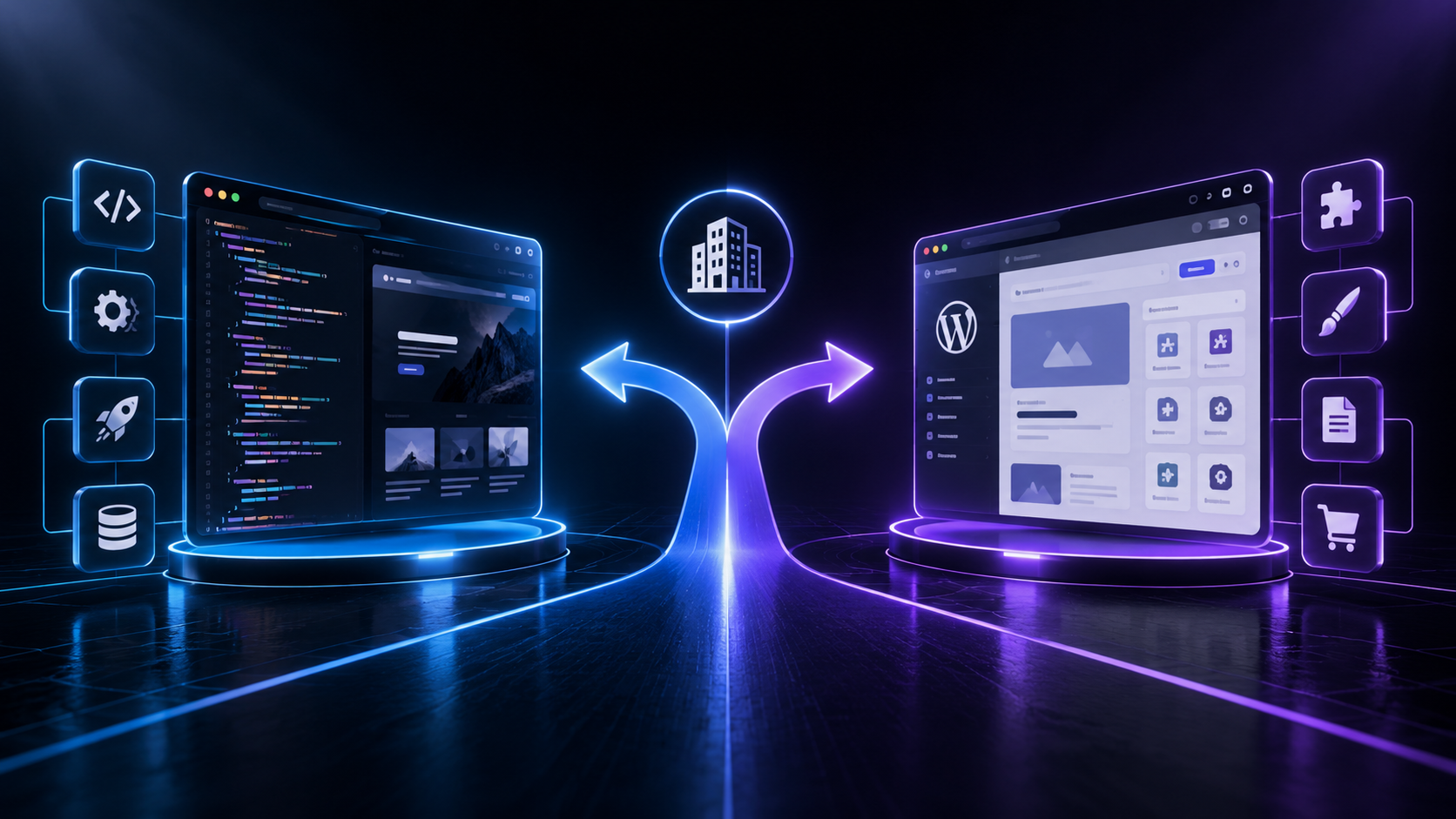
You need a new website.
Then comes the question almost every business eventually asks:
“Should we use WordPress or build a custom website?”
It sounds like a technology decision.
It isn't.
At least, it shouldn't be.
The better question is:
“What does our business actually need from its website?”
Because WordPress can be the right choice for one business and the wrong choice for another.
A custom website can be a smart long-term investment for one company and unnecessary complexity for another.
The goal isn't to choose the more expensive technology.
The goal is to choose the solution that makes sense for your business, audience, goals, budget, content, functionality, and future plans.
The Wrong Way to Compare Them
A lot of website comparisons turn into a technology debate.
WordPress vs custom.
CMS vs code.
Plugins vs components.
Cheap vs expensive.
But technology alone doesn't determine whether a website will perform well.
A well-planned WordPress website can be fast, useful, secure, and effective.
A poorly planned custom website can be slow, confusing, difficult to maintain, and expensive.
The opposite can also be true.
That's why the question shouldn't be:
“Which technology is better?”
It should be:
“Which approach is better for this particular business?”
First, What Do We Mean by “Custom Website”?
The phrase custom website can mean different things.
In this context, we're talking about a website where the design, structure, functionality, and development are built specifically around the business rather than relying primarily on a pre-built WordPress theme and plugin ecosystem.
A custom approach can provide greater control over:
Design
User experience
Page structure
Components
Functionality
Performance strategy
Integrations
Technical architecture
Future development
For example, BrandVerseHQ's own technical approach includes technologies such as Next.js, React, JavaScript, HTML, and CSS, alongside design systems, performance optimization, SEO foundations, analytics, and conversion optimization.
But here's the important part:
Custom does not automatically mean better.
It means more control.
Whether that control creates meaningful value depends on what your business needs.
And What Is WordPress?
WordPress is a content management platform that allows businesses to create and manage websites using themes, plugins, and customizable components.
Its biggest advantage is flexibility without requiring everything to be developed from scratch.
A business can often start with an existing foundation and add functionality as needed.
That can make WordPress particularly practical when:
Content changes frequently
Non-technical users need to manage content
A business needs a familiar CMS
The website needs standard functionality
Time or budget is limited
The business doesn't need highly specialized functionality
For many businesses, that's enough.
And that's an important point.
You don't need custom technology simply because custom technology exists.
So Which One Should You Choose?
The answer depends on the job your website needs to do.
Consider these questions:
How complex is the website?
How frequently will content change?
Who will manage the website?
How unique does the user experience need to be?
What functionality does the business require?
What integrations are needed?
How important are performance and technical control?
What is the realistic budget?
How likely is the website to evolve?
What will happen after launch?
The answers are more useful than the technology label.
Custom Website vs WordPress: At a Glance
Consideration | WordPress | Custom Website |
|---|---|---|
Initial setup | Often faster | Usually requires more planning |
Cost | Can be lower depending on scope | Often higher depending on complexity |
Design control | High, but depends on implementation | Very high |
Content management | Strong CMS capability | Depends on the CMS architecture |
Standard functionality | Often easy to add | Usually developed or integrated specifically |
Specialized functionality | May require plugins/custom development | Greater architectural control |
Performance control | Depends heavily on implementation | Greater control over architecture |
Plugin dependency | Common | Can be minimized |
Maintenance | Themes/plugins require ongoing attention | Depends on architecture and stack |
Scalability | Can scale, depending on implementation | Can be architected around future needs |
Ease of content editing | Usually a strength | Depends on the chosen CMS |
Technical flexibility | High | Very high |
Best fit | Many standard business/content websites | Businesses needing greater control or custom experiences |
The table is a starting point, not a verdict.
1. Start With Your Business Model
A simple informational website and a complex digital platform have very different requirements.
Imagine a local professional service business.
It may need:
Home
About
Services
Team
Testimonials
Blog
Contact
There may be little reason to introduce unnecessary technical complexity.
Now imagine a business that needs:
Complex user journeys
Custom dashboards
Advanced application logic
Specialized workflows
Multiple systems communicating with one another
Highly customized interactions
A product-like digital experience
The requirements are different.
A custom architecture may make more sense.
The business model should influence the technology.
Not the other way around.
2. How Important Is Your Content?
This is one of the biggest considerations.
If your team publishes articles, updates services, changes landing pages, uploads case studies, or manages content frequently, a strong content-management workflow can be extremely valuable.
That's where WordPress has a natural advantage for many businesses.
But custom does not mean “no CMS.”
A custom website can also be connected to a content management system.
The real question is:
Who needs to change what, and how often?
If your team needs to update content without involving a developer every time, design the system around that requirement.
3. How Unique Does the Experience Need to Be?
A template can be perfectly adequate when the business simply needs a clean, professional website.
But some businesses want their website to become a significant part of their differentiation.
They may need:
A completely custom visual language
Unique interactions
Specialized navigation
Custom components
Highly controlled responsive behaviour
Product-like experiences
Complex content structures
In those situations, having greater control over the front-end architecture can become valuable.
This is one of the strongest arguments for custom development.
Your website doesn't have to be different just for the sake of being different.
It should be different when the business experience actually benefits from it.
4. Think About Performance
Performance is often used as an argument for custom websites.
But the reality is more nuanced.
A WordPress website can perform well.
A custom website can perform poorly.
Performance depends on how the website is designed, developed, hosted, and maintained.
That said, a custom architecture can give developers greater control over what is included in the experience.
You can make deliberate decisions about:
What code is loaded
How pages are rendered
How assets are delivered
How components are structured
How data is requested
How third-party services are used
How the site is optimized
So the useful question isn't:
“Is custom faster?”
Ask:
“How much control over performance does this project actually require?”
5. Consider Maintenance
This is where the conversation becomes more interesting.
People sometimes assume:
WordPress = easy forever.
And:
Custom = difficult forever.
Neither is automatically true.
WordPress websites commonly involve themes, plugins, hosting, updates, compatibility, security considerations, and ongoing maintenance.
A custom website has a different maintenance profile.
Its requirements depend on the technology, architecture, hosting, integrations, CMS, and development practices used to build it.
So don't compare “maintenance” as a single number.
Compare the actual system.
Ask:
Who will maintain it?
Who updates content?
Who handles technical issues?
How many third-party dependencies exist?
What happens when something breaks?
How easy is it to modify?
What skills are required?
The cheapest build is not necessarily the cheapest system to own.
6. Think Beyond the Launch Date
This is one of the most important questions:
What might this website need to become in two or three years?
You don't need to build for imaginary problems.
Overengineering a simple website can waste money.
But ignoring obvious future requirements can create unnecessary rework.
Consider a business that expects to eventually add:
A customer portal
Advanced lead management
Membership functionality
Custom dashboards
Personalization
Internal tools
Complex integrations
A web application
If those requirements are already reasonably foreseeable, architecture deserves more attention from the beginning.
The goal isn't to build everything today.
It's to avoid making today's decisions unnecessarily hostile to tomorrow's requirements.
7. Budget Matters — But Look at Total Value
A WordPress website may have a lower initial development cost.
A custom website can require more design, planning, development, testing, and architecture.
But initial cost is only one part of the decision.
Consider:
Build cost
Hosting
Maintenance
Content management
Plugin or service costs
Future changes
Performance work
Redesign or migration costs
Developer dependency
=
Total cost of ownership
You don't need to calculate every number perfectly.
You do need to avoid choosing a platform solely because the first invoice is smaller.
At the same time, don't spend heavily on custom development where a simpler solution already solves the problem.
Good technology decisions balance cost with value.
8. Don't Confuse Custom Design With Custom Development
This distinction is important.
A website can have a completely custom visual design and still use WordPress.
A website can also use a custom development stack while following a relatively simple visual design.
These are different decisions.
Custom design asks:
“How should the experience look and behave?”
Custom development asks:
“How should the underlying website be built?”
You can mix and match.
For example:
Custom design + WordPress
can be a strong solution for a business that wants a distinctive brand experience but also wants a familiar CMS.
And:
Custom design + custom development
can make sense when the business needs deeper control over the entire experience.
9. What About SEO?
This is another area where platform debates can become misleading.
There is no simple rule that says:
WordPress = good SEO
or
Custom = better SEO.
Search performance depends on much more than the platform.
Important considerations include:
Site architecture
Content quality
Search intent
Internal linking
Technical accessibility
Indexability
Metadata
Performance
Structured data where appropriate
Mobile experience
Content organization
Authority and relevance
A technically sophisticated website can still have a poor SEO strategy.
A simpler website can perform well when its content and technical foundation are strong.
SEO is a strategy, not a platform feature.
10. When WordPress May Be the Better Choice
WordPress may make sense when your business needs a relatively standard website with strong content-management capabilities.
It can be a practical choice when:
Your website is primarily content-driven
You publish frequently
Your team needs to manage content
Your functionality is relatively standard
You want to launch quickly
Budget is a major constraint
You don't need highly specialized functionality
You want access to an established ecosystem
For many small businesses, professional services, publishers, organizations, and content-heavy websites, that can be more than enough.
Simple doesn't mean inferior.
Sometimes simple is exactly what the business needs.
11. When a Custom Website May Be the Better Choice
Custom development becomes more compelling when the website itself requires greater control.
It may make sense when:
The experience is a major competitive differentiator
You need highly customized interactions
The project has specialized functionality
Performance requirements are significant
You need tighter control over architecture
The website is expected to evolve into a larger digital product
Complex integrations are involved
Standard CMS or plugin approaches create unnecessary constraints
The business has the budget and capability to support custom development
The key word is requirements.
Not prestige.
Not trends.
Not the belief that custom automatically means premium.
Custom should solve a real problem.
12. When Neither Option Is the Perfect Answer
There is another possibility.
You may not need a full custom website.
And you may not need a traditional WordPress build.
Modern websites can use different combinations of:
Custom frontends
Headless CMS platforms
Managed content systems
APIs
Third-party services
Serverless functions
Specialized SaaS products
Custom backend systems
The best architecture may be a hybrid.
That is why platform selection should happen after requirements are understood.
Don't choose the technology first and then force the business into it.
The Real Decision Framework
Instead of asking:
“WordPress or custom?”
score your requirements across six areas.
01 — Complexity
How complex is the website or application?
Low → WordPress may be sufficient
High → Custom becomes more relevant
02 — Content
How frequently will content change?
High content-management needs → CMS becomes important
03 — Experience
How differentiated does the user experience need to be?
Standard → simpler implementation may work
Highly differentiated → greater custom control may help
04 — Functionality
Does the business need specialized workflows or application logic?
Standard → existing solutions may be enough
Specialized → custom development becomes more attractive
05 — Future
Is the website likely to become a larger digital system?
Stable → optimize for today's needs
Evolving → consider architectural flexibility
06 — Resources
What budget, technical capability, and maintenance capacity does the business have?
Limited resources → avoid unnecessary complexity
Strong resources → custom solutions may provide greater long-term value
A Simple Example
Imagine two businesses.
Business A: Local Professional Service
It needs:
8–12 pages
Service information
Team information
Testimonials
Blog
Contact form
Basic SEO
Analytics
It doesn't require unusual functionality.
A well-built WordPress website could be an entirely reasonable choice.
There is no prize for building a custom application when a simpler system already does the job.
Business B: Growing Digital Platform
It needs:
Custom user journeys
Account functionality
Personalized dashboards
Multiple integrations
Advanced workflows
Specialized data handling
A highly customized interface
Future product expansion
Here, a custom architecture may provide significantly more value.
The requirements justify the additional complexity.
The Best Website Is Not the Most Advanced One
This is perhaps the most important takeaway.
Technology should disappear into the experience.
Visitors don't care whether your website uses WordPress, Next.js, a headless CMS, or another technology.
They care whether:
It loads quickly.
They can find what they need.
They understand the business.
They trust the company.
The experience feels professional.
The website works on their device.
They can take the next step easily.
Technology matters because it enables those outcomes.
Technology is not the product. The experience and business outcome are.
Don't Choose Based on Agency Preference
This is worth saying plainly.
An agency may prefer WordPress.
Another may prefer custom development.
Another may specialize in a particular framework.
That doesn't mean their preferred technology is automatically right for you.
Ask the agency:
Why are you recommending this approach for my business?
A good answer should connect technology to:
Your objectives
Your audience
Your functionality
Your content
Your budget
Your future requirements
Your maintenance model
If the answer is simply:
“Because this is what we use.”
keep asking questions.
Your website should fit your business, not the agency's comfort zone.
What BrandVerseHQ Believes
At BrandVerseHQ, we don't believe every business needs a custom website.
We believe technology should be selected based on what the project actually needs — balancing performance, scalability, maintainability, and user experience.
Our approach is simple:
Understand → Strategize → Design → Develop → Test → Launch → Improve
The technology comes as part of that process.
Depending on the project, that may mean a custom website using technologies such as Next.js and React. It may also mean a different approach when another solution is more appropriate.
The goal isn't to sell complexity.
The goal is to build something useful.
Your business isn't a template. But that doesn't mean every solution needs to be custom.
So, What Should Your Business Choose?
If your website has relatively standard requirements, frequent content updates, and a need for practical content management, WordPress may be the right choice.
If your business needs a highly differentiated experience, specialized functionality, greater technical control, or a foundation for a more complex digital product, custom development may make more sense.
And if you're somewhere in between, a hybrid approach may be worth considering.
There is no universal winner.
There is only the solution that best fits the problem.
Before choosing a platform, answer these questions:
What does the website need to accomplish?
Who will use it?
What functionality does the business actually need?
Who will manage it?
What might it need to become?
What is the business willing to invest in building and maintaining it?
Once those answers are clear, the technology decision becomes much easier.
Frequently Asked Questions
Is WordPress better than a custom website?
Not universally. WordPress can be an excellent choice for many businesses, while custom development can be more appropriate for projects requiring greater control, specialized functionality, or a highly customized experience.
Is a custom website always more expensive?
Usually, custom development requires more planning and development effort, but total cost depends on the project's scope and architecture. A simpler custom website can cost less than a highly customized WordPress implementation, and a complex WordPress project can become expensive.
Is WordPress good for business websites?
Yes. WordPress can be a practical choice for many business websites, particularly when content management and relatively standard functionality are important.
Are custom websites better for SEO?
Not automatically. SEO depends on content, search intent, architecture, technical implementation, performance, internal linking, indexability, and many other factors. The platform alone does not determine search performance.
Can a WordPress website have a custom design?
Yes. WordPress can be customized extensively, including its visual design and functionality. Custom design and custom development are separate decisions.
Can a custom website have a CMS?
Yes. A custom-developed website can be connected to a content management system so that non-technical users can manage appropriate content.
Which is better for a small business?
It depends on the business. If the requirements are straightforward and budget or content management are important, WordPress may be a sensible option. If the business has specific functionality or experience requirements, custom development may provide more value.
Should I choose technology before hiring a web development agency?
Ideally, no. Start with your business objectives and requirements. A capable agency should be able to explain which technology or architecture best supports those requirements and why.
Final Thought
The WordPress vs custom debate is often framed as a technology decision.
It is really a business decision.
Don't choose the platform that sounds most advanced.
Don't choose the cheapest option simply because the initial price is lower.
And don't choose custom development simply because it sounds more premium.
Choose the approach that gives your business the right balance of:
Experience.
Performance.
Flexibility.
Maintainability.
Cost.
Scalability.
Business value.
Because the goal isn't to build the most complicated website.
It's to build the right website for the business behind it.
Build what you need. Build it well. Build for what's next.
Build. Grow. Evolve.
— BrandVerseHQ