SEO, GEO, and AEO are increasingly used to describe how businesses can become visible across traditional search and AI-powered discovery. But do you actually need three different strategies?
A few years ago, the search strategy was relatively straightforward.
You wanted your business to appear on Google.
So you invested in:
SEO → Rankings → Clicks → Website → Conversion
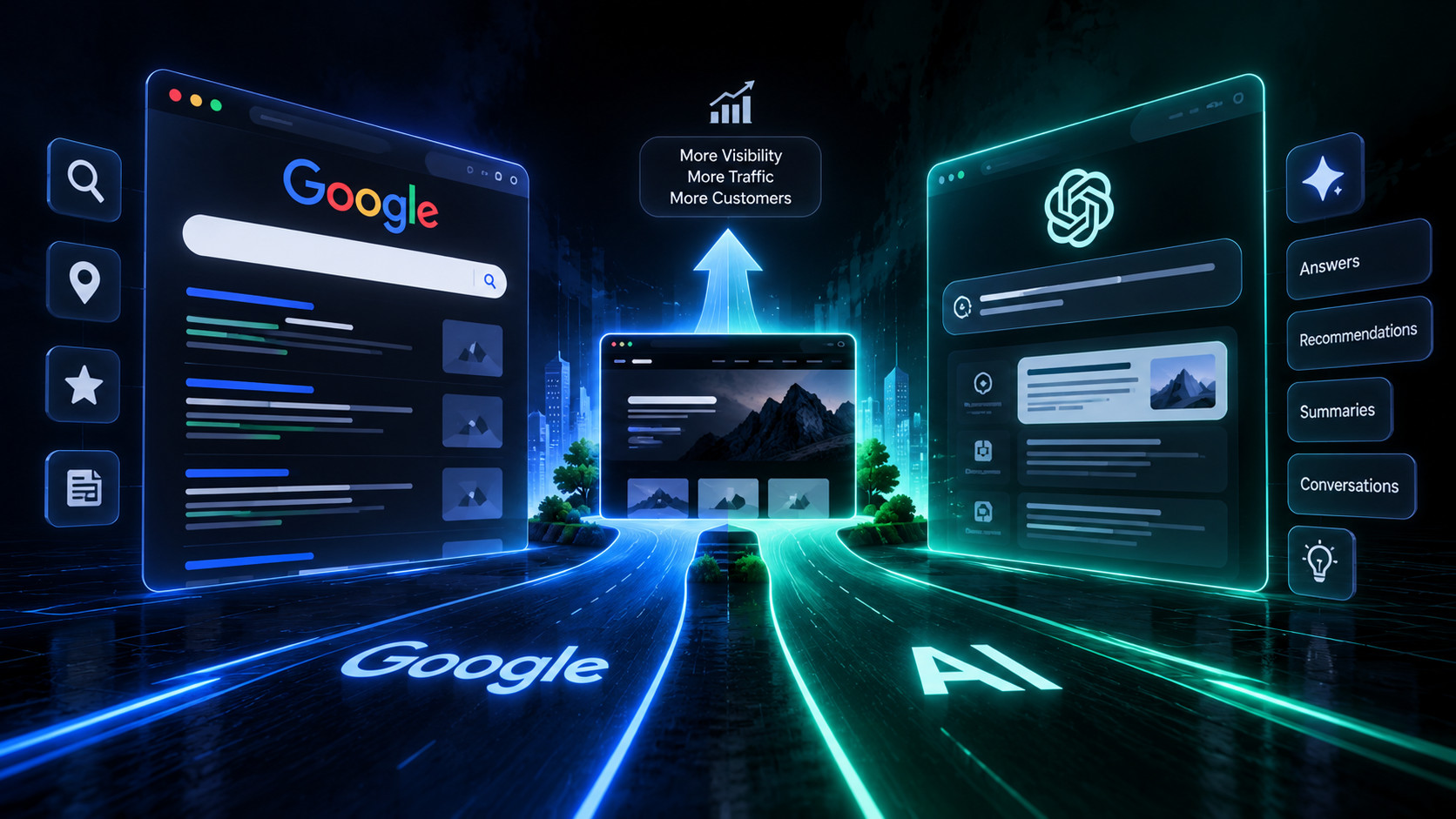
Now the search journey is changing.
People still use Google.
But they are also asking AI systems questions, comparing businesses through conversational interfaces, looking for summarized answers, and increasingly expecting technology to help them evaluate options.
That has created a new collection of terms:
SEO.
AEO.
GEO.
AI Search Optimization.
LLM Optimization.
AI Visibility.
For businesses, this can quickly become confusing.
Do you need SEO?
Should you hire a GEO agency?
Is AEO replacing SEO?
Should you create separate content for Google and AI?
The short answer is:
Most businesses do not need three completely separate strategies. They need a stronger search and digital visibility system that works across multiple discovery environments.
The terminology matters less than the underlying objective:
Be discoverable.
Be understandable.
Be relevant.
Be trusted.
Be useful.
Be easy to choose.
SEO vs AEO vs GEO: What Do These Terms Mean?
Before deciding what your business needs, it helps to understand the terminology.
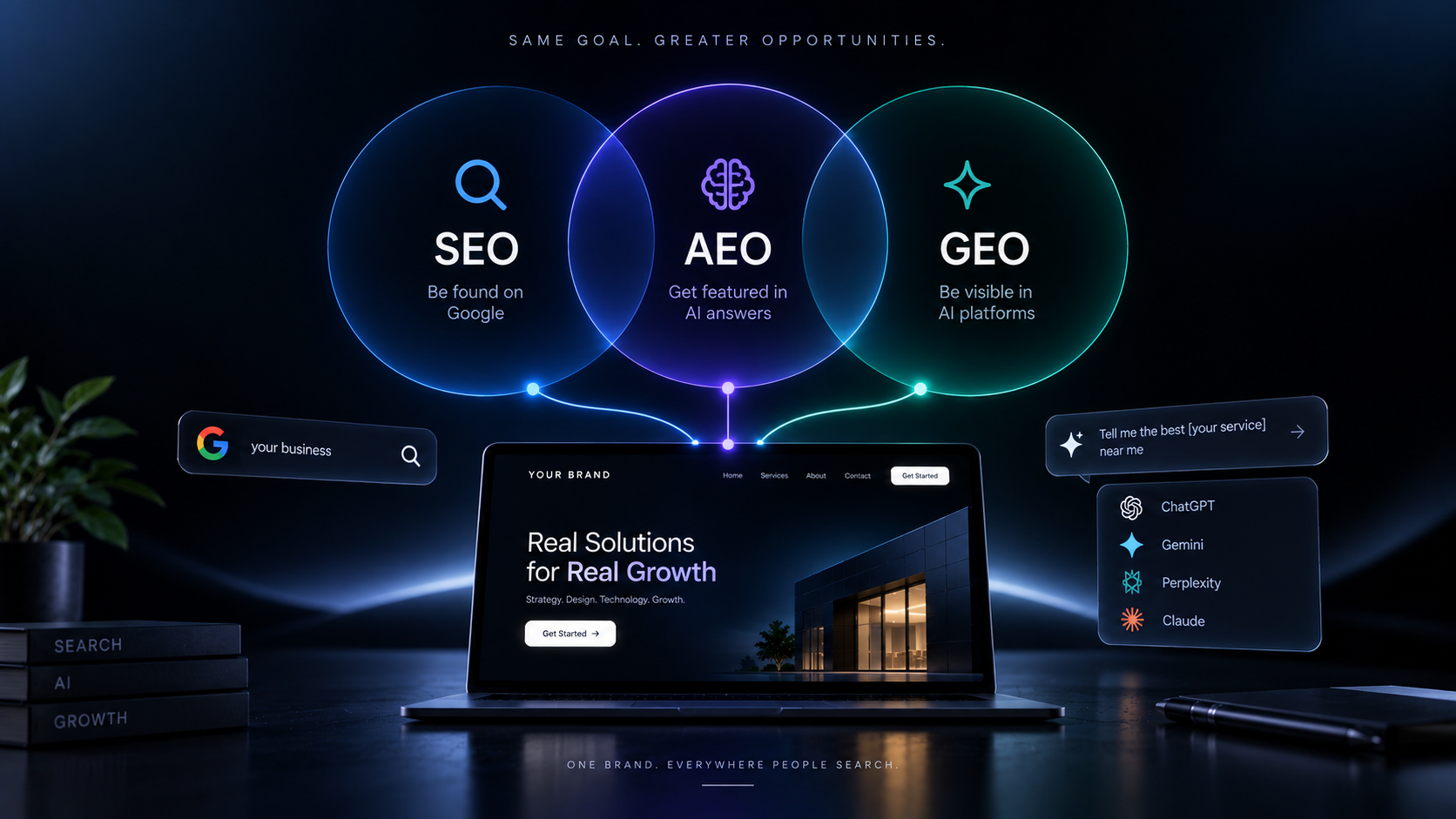
SEO — Search Engine Optimization
SEO is the broad discipline of improving a website's ability to be discovered and understood through search engines.
It includes areas such as:
Technical accessibility
Site architecture
Content
Search intent
Internal linking
Metadata
Page experience
Authority
Local search
Structured data
Search performance measurement
The goal is not simply to "rank."
The larger objective is to earn relevant visibility from people searching for problems, products, services, businesses, and information.
AEO — Answer Engine Optimization
AEO is commonly used to describe efforts aimed at making content useful and understandable for systems that provide direct answers to questions.
Instead of only thinking:
"How do I rank for this keyword?"
the thinking becomes:
"How can my content clearly answer the question a person is asking?"
That can involve:
Direct answers
Clear definitions
Question-based content
Structured information
Concise explanations
Strong topical coverage
Useful FAQs
Well-organized pages
Evidence and sources
AEO is therefore closely related to content quality and information architecture.
It focuses more heavily on answerability.
GEO — Generative Engine Optimization
GEO is generally used to describe optimization for generative AI experiences where systems synthesize information and produce answers, summaries, comparisons, or recommendations.
The objective can go beyond getting a traditional search result click.
A business may want its:
Brand
Website
Products
Services
Expertise
Content
Research
Sources
to be understood and potentially referenced by AI systems.
That creates a different kind of visibility.
Instead of:
"Did we rank #3?"
the question may become:
"Was our business considered, mentioned, cited, or recommended when someone asked an AI system about our category?"
That is a fundamentally different user experience.
So Which One Is More Important?
This is where businesses can get distracted by terminology.
The answer is not:
SEO vs AEO vs GEO.
It is:
SEO + Answerability + AI Visibility
The three concepts overlap considerably.
A technically inaccessible website is unlikely to become stronger simply because you label your strategy "GEO."
A website with weak information architecture will not become authoritative because you added an AI-related acronym.
And a website with no useful information will struggle to become a trusted source regardless of what optimization label you use.
The foundation still matters.
SEO Is Not Dead
This is probably the first misconception to remove.
AI-powered search does not make traditional SEO irrelevant.
Google's current guidance around generative AI features continues to emphasize established SEO fundamentals, including making content accessible to search systems and providing useful, original information. Google has also explicitly addressed misconceptions around "AEO/GEO" in its generative AI search guidance.
That makes sense.
AI systems still need information.
And websites still need to be:
Accessible
Crawlable
Understandable
Relevant
Useful
Credible
The interface may change.
The underlying requirement for high-quality information does not disappear.
What Actually Changes With AI Search?
The biggest change is not necessarily the disappearance of search.
It is the way information gets presented.
Traditional search often creates a journey like:
Query → Search Results → Click → Website → Decision
AI-assisted discovery can create something closer to:
Question → AI Interpretation → Synthesized Answer → Sources / Recommendations → Decision
The user may interact with several sources before ever visiting a website.
In some cases, the AI system may help narrow the user's choices.
That changes the importance of things like:
Brand clarity
Entity understanding
Authority
Citations
Original evidence
Content structure
Topical depth
Third-party validation
The business is no longer competing only for a position on a results page.
It may also be competing to become part of the answer itself.
The New Visibility Journey
Traditional SEO often focuses heavily on:
Impression → Ranking → Click
AI-mediated discovery introduces additional possibilities:
Discovery → Understanding → Retrieval → Mention → Citation → Recommendation → Consideration → Conversion
These are not guaranteed stages, and different systems work differently.
But they represent an important strategic shift.
The value of visibility can increasingly exist before the click.
Someone may encounter your brand through an AI-generated answer.
They may then search for your company directly.
They may compare you with competitors.
They may visit your website later.
Or they may never click the source at all.
That means brand visibility and authority can influence the journey even when traditional click-through measurement doesn't capture the entire interaction.
SEO Builds the Foundation
Think of SEO as the foundation of the system.
It helps make your digital presence discoverable and understandable.
Important areas include:
Technical Foundation
Crawlability
Indexability
Site architecture
Performance
Mobile experience
Clean URLs
Internal linking
Content Foundation
Search intent
Useful pages
Topic coverage
Clear headings
Original information
Relevant supporting content
Authority Foundation
Credible references
Earned mentions
Reviews
Relevant links
First-party expertise
Demonstrated experience
Measurement
Search impressions
Organic clicks
CTR
Search positions
Queries
Landing pages
Conversions
These fundamentals remain useful regardless of whether a user discovers your business through a traditional search result or an AI-powered experience.
AEO Adds an Answer Layer
AEO becomes particularly useful when you start asking:
Can a system quickly understand and extract the answer from our content?
That means your content should be structured around real questions.
For example:
Instead of writing a page that vaguely discusses accounting services, answer questions such as:
What does a business accountant do?
Give a direct explanation.
When should a small business hire an accountant?
Give a useful answer.
How much does business accounting typically involve?
Explain the factors rather than inventing a universal number.
What should a business prepare before hiring an accountant?
Provide a practical checklist.
The content becomes more useful to humans.
And clearer information is generally easier for machines to interpret as well.
GEO Adds a Broader AI Discovery Layer
GEO is broader than simply answering questions.
AI systems can potentially be used for:
Comparisons
Recommendations
Research
Product discovery
Vendor selection
Travel planning
Local business discovery
Software evaluation
Service comparisons
Imagine someone asking:
"What are some good web design agencies for a growing professional services business?"
That is not simply an informational query.
It is a consideration query.
The user is asking an AI system to help narrow the market.
That creates a different visibility challenge.
Your business needs more than a page that answers:
"What is web design?"
It needs enough context, credibility, relevance, and evidence for the business to be understood as a legitimate option.
AEO and GEO Are Not Magic Content Formats
There is a common temptation to believe that AI search requires a secret content format.
It doesn't.
You don't need to turn every page into:
Question
Answer
Question
Answer
Question
Answer
just because AI systems exist.
You need to create information that is:
Clear
Specific
Useful
Well-structured
Relevant
Evidence-based
Easy to understand
Sometimes that will look like an FAQ.
Sometimes it will be a detailed guide.
Sometimes it will be a comparison.
Sometimes it will be a case study.
Sometimes it will be original research.
Sometimes it will simply be a well-written service page.
Format should follow intent.
Entity Clarity Is Becoming More Important
A business should be easy to understand as an entity.
Imagine an AI system encountering a company name.
Can it understand:
What the company is
What it sells
Who it serves
Where it operates
Which industry it belongs to
What makes it different
What evidence supports its claims
If the answer is unclear, visibility becomes harder.
This is why consistent information matters across your digital presence.
Your:
Website → About pages → Business profiles → Author information → Social profiles → Third-party mentions → Reviews → Publications
should tell a reasonably consistent story.
Not identical copy.
Consistent identity.
Structured Data Helps With Understanding
Structured data can help search systems understand specific information about a page or entity.
Depending on the website, that can include structured information about:
Organization
Local business
Product
Article
Event
Breadcrumbs
Reviews
Software
Other supported entities
Google describes structured data as a way to help it understand page content and potentially support certain search features.
But structured data isn't a magic "AI ranking" switch.
Adding schema does not guarantee:
Higher rankings
AI citations
Recommendations
Traffic
Conversions
It is part of a broader technical and information architecture.
Original Information Matters More
As AI-generated content becomes easier to produce, generic information becomes easier to reproduce.
That makes original information more valuable.
For example:
Generic
"A good website should be fast, mobile-friendly, and user-friendly."
True.
But not particularly distinctive.
More useful
"After reviewing 50 service-business websites, we found that the most common conversion problems were not visual. They were unclear service positioning, weak trust signals, and no obvious next action."
Now there is an original observation.
Even stronger would be:
Research → Method → Data → Finding → Interpretation
That creates information other websites cannot simply rewrite from existing articles.
Authority Is More Than Backlinks
Traditional SEO has long emphasized links.
They still matter.
But modern digital authority can involve many signals and forms of evidence.
Consider:
Relevant links
Expert authorship
Original research
Case studies
Industry recognition
Customer reviews
Third-party mentions
Published expertise
Community discussions
Consistent brand information
Demonstrated experience
The broader question becomes:
Why should anyone believe this business knows what it is talking about?
That question matters to humans.
It also matters when digital systems try to evaluate sources.
The Biggest GEO Mistake: Optimizing for Visibility Without Business Value
Suppose an AI system mentions your company.
That sounds great.
But what happens next?
If the mention creates no meaningful business opportunity, the metric may not matter much.
This is why AI visibility should connect to business outcomes.
Track the path where possible:
AI Visibility → Website Visit → Engagement → Lead → Qualified Opportunity → Customer → Revenue
The exact measurement will vary.
But the principle is important:
Visibility is valuable when it contributes to business outcomes.
Current industry discussion is increasingly making the same distinction: being cited or mentioned is a visibility signal, not the final business result.
Don't Chase “#1 in ChatGPT”
This deserves special attention.
You may encounter services promising:
"We'll make your business #1 in ChatGPT."
Be careful.
AI-generated answers can vary based on:
User context
Prompt wording
Location
Model
Search/retrieval behavior
Freshness
Sources
Personalization
Conversation history
There is no universal equivalent of:
"Rank #1 in ChatGPT."
AI visibility measurement is still developing.
A better question is:
"How often is our business appropriately represented across relevant AI discovery scenarios, and is that visibility contributing to qualified demand?"
That is much closer to a real business question.
So What Does Your Business Actually Need?
This is the most important section.
Not every business needs a massive GEO program.
Your needs depend on:
Business model
Search demand
Customer journey
Industry
Competition
Brand maturity
Geographic market
Content depth
Existing authority
Digital infrastructure
Business goals
Here's a practical framework.
If Your Website Has Basic Problems
Start with:
SEO Foundation
Focus on:
Technical SEO
Website structure
Mobile experience
Performance
Indexability
Clear service/product pages
Search intent
Internal linking
Analytics
Do not jump straight to GEO.
If your website isn't fundamentally strong, build the foundation first.
If You Have Traffic But Weak Answers
Add:
AEO / Answer-Oriented Content
Focus on:
Customer questions
Search intent
Definitions
Comparisons
FAQs
How-to content
Clear explanations
Decision-support content
Your goal is to become genuinely useful.
If Your Category Is Competitive and AI Discovery Matters
Add:
AI Search / GEO Layer
Focus on:
Entity clarity
Brand authority
Original research
Expert content
Citations
Third-party validation
Relevant mentions
Structured data
Content designed around complex decision journeys
AI visibility measurement
This is where GEO becomes strategically useful.
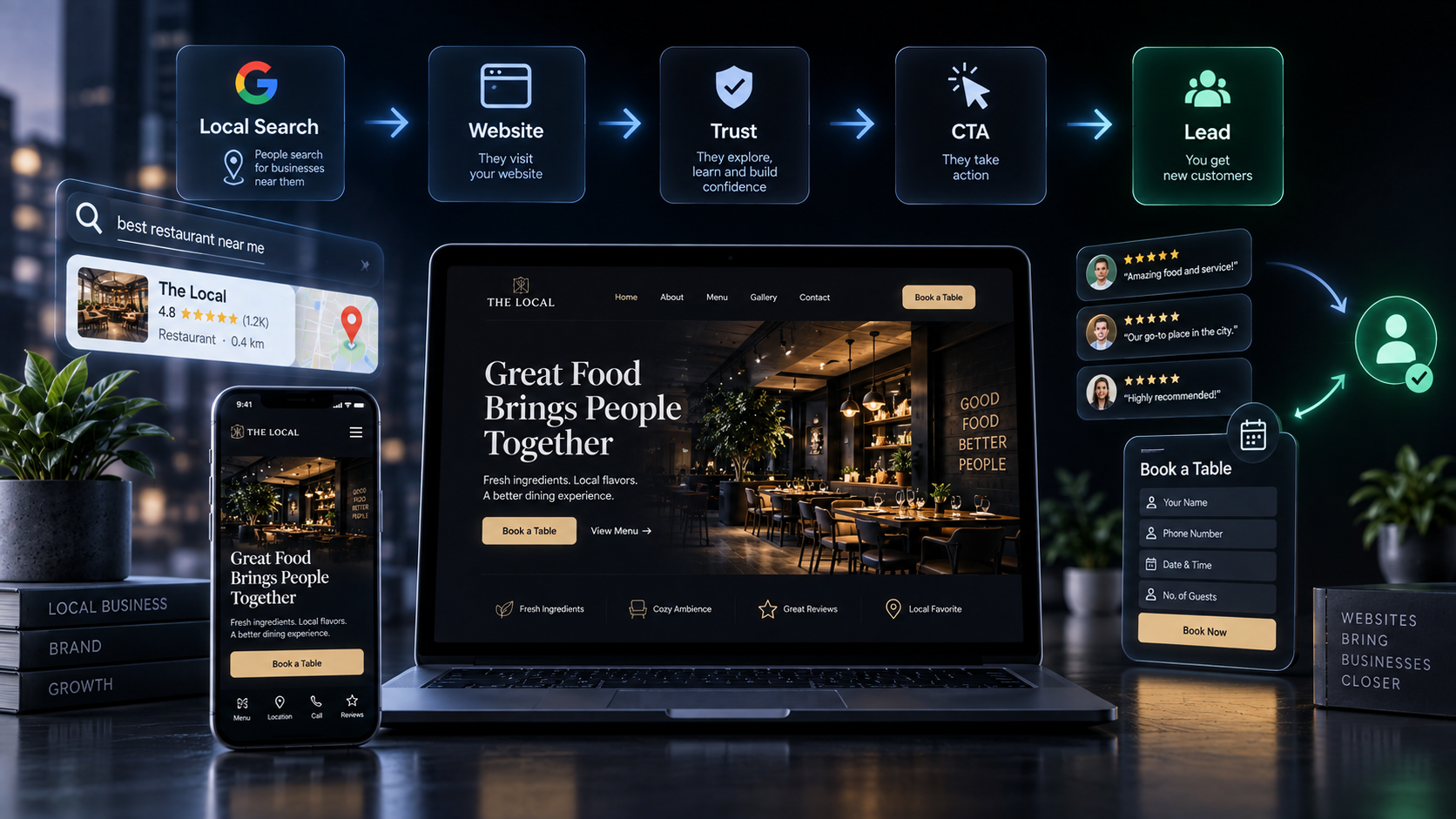
If You Are a Local Business
Prioritize:
Local SEO + Website + Reputation + AI Visibility
Make sure your:
Business information
Location
Services
Hours
Reviews
Website
Local profiles
Service areas
are accurate and consistent.
Then build useful content around the questions local customers actually ask.
AI discovery does not eliminate local relevance.
It can make clear business information even more useful.
A Simple Decision Framework
Business situation | Priority |
|---|---|
New website | SEO + technical foundation |
Poor rankings | SEO fundamentals + content |
Ranking but low CTR | Search presentation + messaging |
Traffic but low conversions | UX + CRO + trust |
Lots of customer questions | AEO / answer-oriented content |
Competitive category | SEO + authority + original content |
Strong brand with AI visibility goals | SEO + entity + AI Search/GEO |
Local business | Local SEO + reputation + website |
SaaS / technology company | SEO + technical content + authority + AI visibility |
Enterprise brand | Integrated search + content + authority + AI visibility |
The key is sequencing.
Foundation first.
Then relevance.
Then authority.
Then broader AI visibility.
The Modern Search Visibility Stack
Instead of thinking about three competing disciplines, think about a layered system.
Layer 1 — Technical Foundation
Can systems access and understand the website?
Layer 2 — Search Visibility
Can people discover the business through traditional search?
Layer 3 — Answerability
Can the content directly and clearly answer important questions?
Layer 4 — Entity Clarity
Can systems understand who the business is and what it does?
Layer 5 — Authority
Is there evidence that the business is credible?
Layer 6 — AI Visibility
Does the brand appear appropriately in AI-powered discovery?
Layer 7 — Conversion
Can the resulting attention become meaningful business action?
Layer 8 — Measurement
Can the business understand what is actually contributing to growth?
That creates:
SEO → AEO → Entity → Authority → AI Visibility → Conversion → Growth
These aren't isolated silos.
They're connected layers.
What Should Your Content Strategy Look Like in 2026?
Don't start by asking:
"What content do we need for GEO?"
Start with:
"What does our audience need to know before choosing us?"
Then build around that.
A strong content system can include:
Educational Content
Help people understand the problem.
Comparison Content
Help them evaluate options.
Service Content
Explain what you actually offer.
Decision Content
Help prospects choose the right approach.
Case Studies
Show evidence.
Original Research
Create information others can reference.
Expert Content
Demonstrate knowledge.
FAQs
Remove common uncertainty.
Tools
Provide practical utility.
This creates a much stronger knowledge system than publishing hundreds of generic AI-generated articles.
AI Can Help You Produce Content — But It Shouldn't Become the Strategy
AI can be extremely useful for:
Research
Topic discovery
Outlining
Content analysis
Drafting
Editing
Content audits
Internal linking suggestions
Competitor research
Query clustering
But the strongest content still needs:
Human insight + Original information + Experience + Judgment
A useful workflow is:
AI Research → Human / Client Insight → Original Angle → AI-Assisted Draft → Human Review → Publish → Measure → Improve
This protects the content from becoming generic.
What Businesses Should Stop Doing
If you're adapting your search strategy for 2026, stop doing things simply because they sound like SEO, AEO, or GEO.
Stop publishing generic articles just to hit a keyword target.
Stop creating hundreds of near-identical location pages.
Stop stuffing questions into pages because you heard AI likes questions.
Stop adding schema without understanding what information it represents.
Stop treating backlinks as the only form of authority.
Stop measuring AI visibility without connecting it to business outcomes.
Stop promising guaranteed AI rankings.
Stop buying every new "GEO tool" that appears.
And most importantly:
Stop optimizing for the acronym instead of the customer.
What Businesses Should Start Doing
1. Build a strong technical foundation
Make your website accessible, fast, structured, and understandable.
2. Understand search intent
Know what your audience actually wants when they search.
3. Answer real questions
Create useful information around real customer problems.
4. Build topical depth
Cover important subjects meaningfully instead of producing disconnected articles.
5. Clarify your entity
Make it easy to understand who your business is, what it does, and who it serves.
6. Build authority
Create evidence, expertise, research, case studies, and credible references.
7. Strengthen your brand
AI discovery is not only about pages. Brand understanding matters.
8. Measure visibility
Track traditional search performance and, where practical, AI visibility signals.
9. Connect visibility to conversion
The ultimate goal is not impressions.
It is meaningful business growth.
The Better Question Isn't “SEO or GEO?”
The better question is:
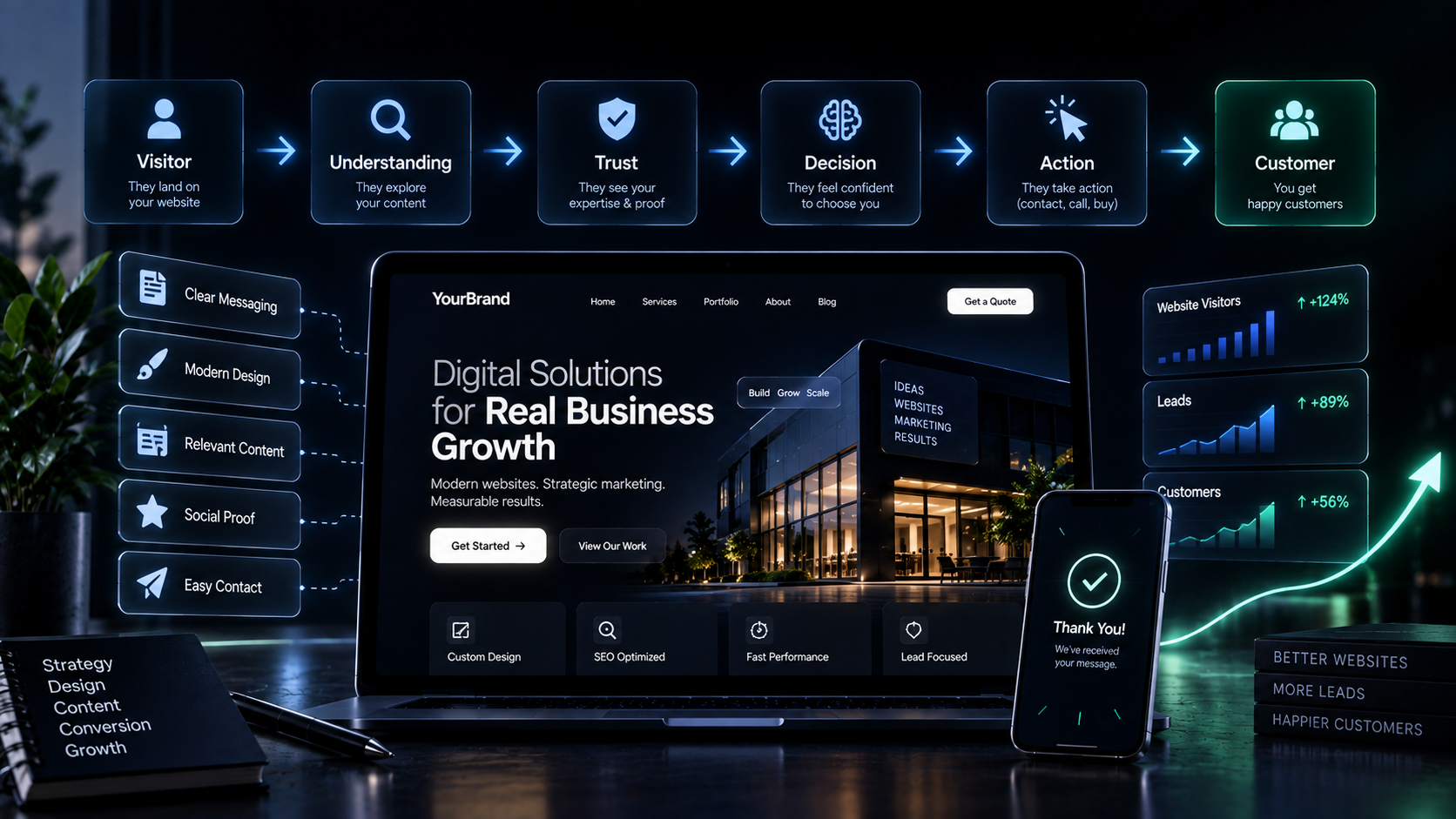
"How does our business need to be discovered, understood, trusted, and chosen?"
That question leads to a better strategy.
For some businesses, the answer will be:
Fix SEO first.
For others:
Build better content.
For others:
Strengthen local search and reputation.
For mature brands:
Build authority and AI visibility.
For most businesses:
Do all of these progressively, in the right order.
The BVHQ Perspective
At BrandVerseHQ, we don't see SEO, AEO, and GEO as three disconnected products that businesses need to purchase separately.
We see them as parts of a broader Digital Growth and Search Visibility system.
The foundation is:
Brand → Website → Search → Content → Visibility → Trust → Conversion → Analytics → Optimization
And AI Search Visibility becomes another layer inside that system.
That can include:
Technical accessibility
Entity clarity
Structured data
Answer-oriented content
Authority
Citations
Local search
AI visibility measurement
This aligns with the broader BVHQ approach: start with the business problem, understand the current digital presence, identify meaningful opportunities, and recommend the right next step rather than adding technology for its own sake.
The objective isn't to become an "AEO business" or a "GEO business."
The objective is to help businesses become more discoverable, more understandable, more trusted, and more valuable across the evolving digital search journey.
Key Takeaways
SEO is still foundational.
AEO focuses heavily on answerability and direct information needs.
GEO is commonly used for visibility in generative AI discovery and recommendations.
The three concepts overlap significantly.
You usually don't need three completely separate strategies.
Technical accessibility and useful content remain important.
Entity clarity and authority become increasingly valuable as AI systems influence discovery.
Structured data can help machines understand information, but it is not a magic ranking mechanism.
Original research, expertise, evidence, and useful information can create stronger long-term visibility.
AI visibility should ultimately connect to business outcomes.
Avoid promises like "#1 in ChatGPT."
Choose your priorities based on your business model, audience, market, and customer journey.
The future of search isn't simply:
SEO vs GEO vs AEO.
It is:
Can your business be found?
Can it be understood?
Can it be trusted?
Can it become part of the answer?
And can that visibility create real business value?
That's the strategy worth building.
Frequently Asked Questions
Is SEO still important in 2026?
Yes. SEO remains a core part of search visibility. AI-powered search experiences still depend on accessible, useful, relevant information, and Google continues to emphasize SEO fundamentals alongside its guidance for generative AI features.
Is GEO replacing SEO?
No. GEO is better understood as an additional way of thinking about visibility in generative AI environments. Many of the technical, content, authority, and user-focused principles overlap with SEO.
What is the difference between AEO and GEO?
AEO generally emphasizes making information clear and useful as answers to questions. GEO is commonly used more broadly for visibility within generative AI systems that synthesize information, compare options, or make recommendations.
Does every business need GEO?
No. The appropriate strategy depends on the business, audience, industry, competition, customer journey, and existing digital foundation.
Should I create separate content for Google and AI search?
Usually, don't start by creating two completely separate content systems. Create genuinely useful, well-structured content that serves users first and can be understood by multiple discovery systems.
Does structured data improve AI visibility?
Structured data can help search systems understand certain information about a page or entity, but it should be treated as part of a broader technical and content strategy rather than a guaranteed AI visibility tactic.
Can a business guarantee a #1 position in ChatGPT?
A guarantee like that should be treated with skepticism. AI responses can vary by system, query, context, sources, and other factors. A better goal is to measure relevant AI visibility and its contribution to business outcomes.
What should a small business prioritize first?
Start with a strong website, technical SEO, clear service information, local visibility, useful content, trust signals, and conversion fundamentals. Once those foundations are strong, AI search visibility can become part of the broader strategy.
Final Thought
The search landscape is changing.
But the fundamental business challenge hasn't changed.
People still need to:
Find you.
Understand you.
Trust you.
Choose you.
The interfaces through which they do that are simply expanding.
Google search.
AI Overviews.
AI Mode.
Conversational search.
Recommendation systems.
Other AI-powered discovery experiences.
So don't build your strategy around the latest acronym.
Build a digital presence that deserves to be discovered.
Be findable.
Be understandable.
Be useful.
Be credible.
Be worth recommending.
That's what search visibility should mean in 2026.