For years, businesses have approached SEO with a familiar goal:
Get to the first page of Google.
That goal still matters.
But search is changing.
People increasingly discover information through more than a traditional list of blue links. Search experiences are becoming more conversational, answer-oriented, and increasingly influenced by AI.
That creates a new challenge for businesses:
How do you make sure your business can be discovered, understood, and trusted across modern search experiences?
The answer isn't to abandon SEO.
It is to build a stronger foundation for search visibility as a whole.
SEO Isn't Disappearing. Search Is Expanding.
SEO is sometimes discussed as though AI has made traditional search optimization obsolete.
That's the wrong way to look at it.
People still search for businesses, products, services, solutions, comparisons, and answers.
What is changing is how those searches are experienced.
A user might:
Search Google directly
Read traditional search results
Interact with an AI-generated answer
Ask a conversational AI a follow-up question
Search for recommendations
Compare multiple businesses
Discover a company through content rather than its homepage
The surface may change.
The underlying requirement remains remarkably consistent:
Be useful, relevant, understandable, and credible.
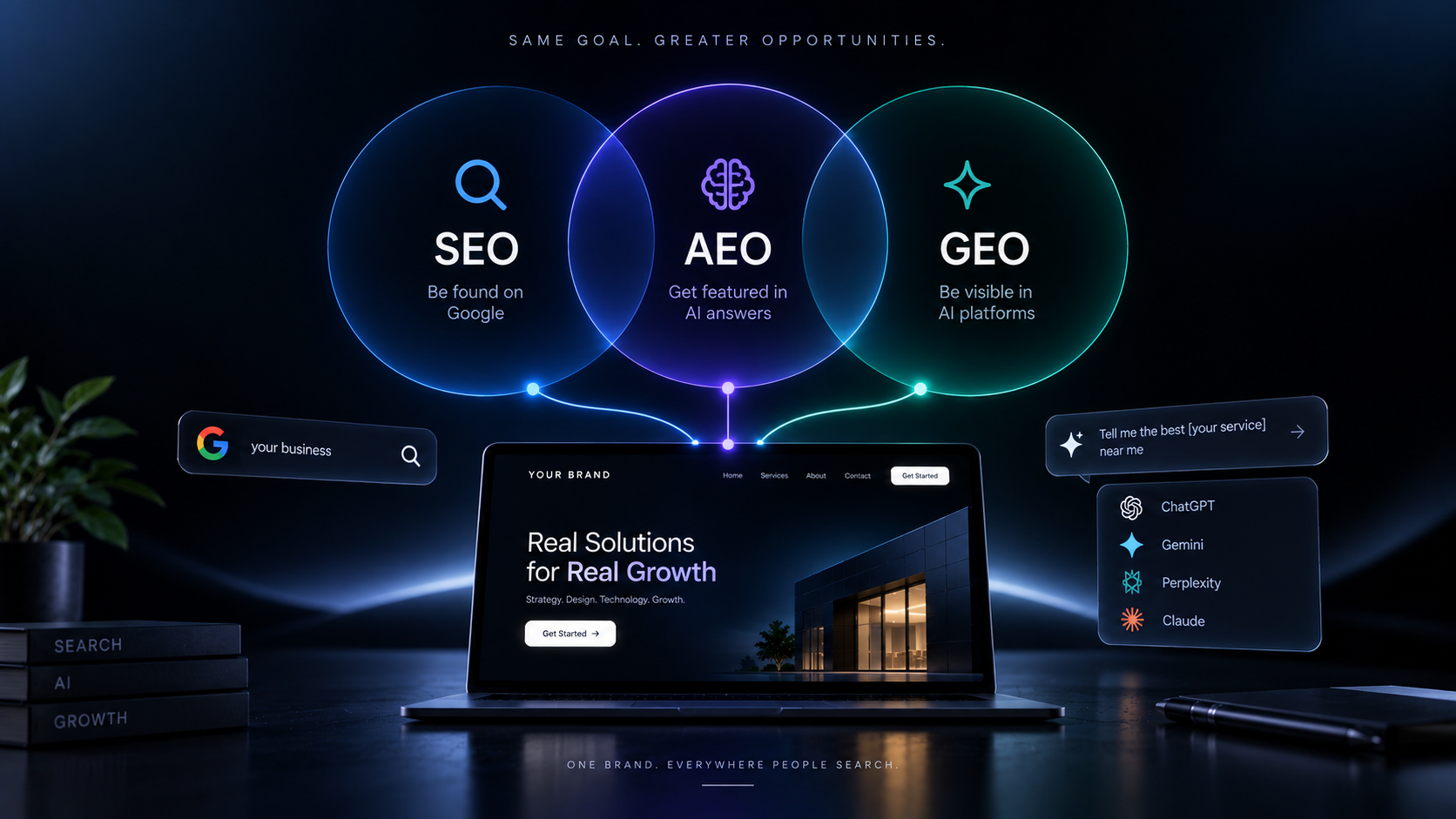
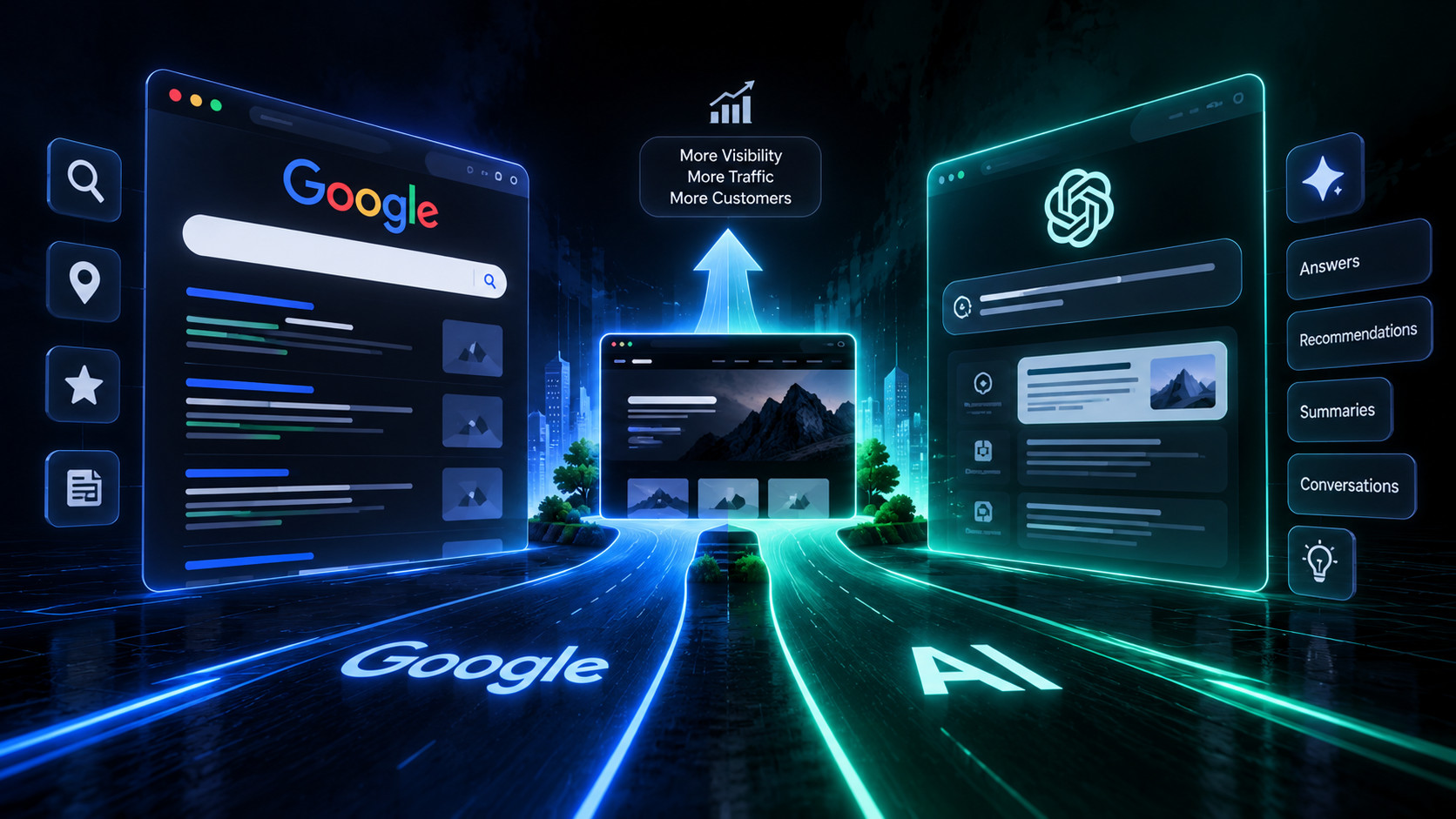
That is why the future of search isn't simply about choosing between SEO and AI search.
It is about building a digital presence that can be understood across both.
The Old Search Model vs. the Emerging Search Model
The traditional SEO mindset often looks like this:
Keyword → Ranking → Click → Website
That model is still relevant.
But modern discovery can look more like:
Question → Search / AI → Information → Recommendation → Website → Decision
Sometimes the website visit comes immediately.
Sometimes it comes later.
Sometimes the user encounters the brand before visiting the website at all.
This changes what businesses should optimize for.
Instead of asking only:
“What keywords can we rank for?”
start asking:
“What questions does our audience ask, and how can our business become a useful, credible answer?”
What AI Search Changes
AI-powered search can change how people discover and evaluate businesses.
Instead of manually opening ten search results, a user may ask a more natural question:
“What are the best website development companies for a growing business?”
Or:
“What should a law firm look for when choosing a website development agency?”
Or:
“Compare these approaches and explain which one makes sense for a small business.”
These are not always traditional keyword queries.
They are questions, problems, comparisons, and decisions.
That means businesses need content that addresses the underlying intent rather than simply repeating a target keyword.
Search Intent Matters More Than Keyword Repetition
A keyword is a useful signal.
But the keyword itself isn't the whole search.
Consider:
“website design”
What does the person actually want?
They might be:
Learning what website design means
Looking for inspiration
Comparing agencies
Looking for pricing
Searching for a specific service
Ready to hire someone
The words are similar.
The intent can be completely different.
A strong search strategy therefore asks:
What does this person actually want to accomplish?
That question should influence the page, content, structure, examples, and CTA.
Don't optimize only for the words people type. Optimize for what they mean.
Build Content Around Questions, Not Just Keywords
One of the biggest opportunities in modern search is creating genuinely useful content around the questions your audience already has.
For a website development company, that might include:
How much does a business website cost?
Should a business use WordPress or custom development?
Why isn't my website generating leads?
How long does a website redesign take?
What makes a website high-performing?
How does website performance affect user experience?
What should a business include on a service page?
Should SEO be considered before launching a website?
Notice something about these topics.
They aren't simply keyword variations.
They represent real decisions and problems.
That makes them useful to people regardless of whether they discover the article through Google, social media, referral traffic, or an AI-powered search experience.
Make Your Business Easy to Understand
Search engines and AI systems need to understand what your business is about.
Humans do too.
Your website should make fundamental information clear:
What does the business do?
Who does it serve?
What products or services does it provide?
What problems does it solve?
What locations or markets does it serve?
What makes it different?
What evidence supports its claims?
This is where entity clarity becomes important.
Your business shouldn't appear as a collection of disconnected pages.
Your website should communicate a coherent picture of:
Business → Services → Audience → Expertise → Evidence → Context
The clearer that relationship is, the easier it becomes for people and systems to understand what your business represents.
Your Website Is the Foundation
AI search visibility doesn't eliminate the importance of your website.
It makes the quality of your digital foundation even more important.
Your website should provide clear signals about:
Business identity
Who are you?
Services
What do you actually provide?
Audience
Who is it for?
Expertise
What do you know?
Evidence
Why should anyone believe you?
Content
What useful questions can you answer?
Structure
How is all of this information organized?
A website that is difficult for users to understand is unlikely to become easier for machines to understand simply because AI exists.
Machine readability starts with human clarity.
Technical SEO Still Matters
AI search does not make technical SEO irrelevant.
Your content still needs to be accessible and organized properly.
Important foundations can include:
Crawlable pages
Logical site architecture
Search-friendly URLs
Clear headings
Internal linking
Useful metadata
Mobile-friendly implementation
Strong performance
Appropriate structured data
Indexability
Semantic page structure
These aren't glamorous.
But they form the infrastructure through which your content can be discovered and understood.
Your source framework similarly treats SEO + Search Intent as part of the website planning process rather than something added at the end.
Good SEO begins before publishing.
Structured Data Can Help Clarify Meaning
A search engine needs to understand what a page represents.
Is it an article?
A service?
A product?
An organization?
A local business?
An event?
Structured data can provide additional context where appropriate.
It shouldn't be treated as a magic ranking switch.
Instead, think of it as part of a larger goal:
Make important information easier for systems to interpret correctly.
Technical implementation matters.
But structured data cannot compensate for weak content or an unclear business proposition.
Authority Is More Than Publishing More Articles
One of the easiest ways to misunderstand AI search is to assume:
“We just need to publish 500 AI-generated articles.”
More content does not automatically create authority.
In fact, generic content can become increasingly interchangeable.
A stronger strategy is to create information that contains something genuinely valuable:
Original research
First-party insights
Case studies
Real examples
Expert analysis
Unique data
Customer questions
Industry experience
Practical frameworks
Lessons from actual projects
Your broader BVHQ content strategy similarly emphasizes that generic AI-generated articles are a weak long-term moat and recommends combining AI research with human or client insight, an original angle, and human review.
AI can help produce content. It shouldn't replace the reason people should care about the content.
Answer the Question Completely
A common SEO mistake is writing an article that technically answers a query but leaves the reader with five new unanswered questions.
For example:
“What is website SEO?”
A weak article might define SEO in two paragraphs and stop.
A stronger resource might explain:
What SEO does
Why it matters
How search intent works
What technical SEO includes
How content fits in
How performance matters
What businesses should measure
What common mistakes to avoid
What to do next
The objective isn't maximum length.
It is complete usefulness.
The reader should finish with a better understanding of the problem than when they started.
Write for Humans First
AI systems are changing.
Search interfaces are changing.
Algorithms are changing.
But people still decide whether something is useful.
That means your content should remain:
Clear
Specific
Well-structured
Accurate
Useful
Relevant
Easy to scan
Written in natural language
Don't turn every sentence into an SEO exercise.
Don't repeat the same phrase because a keyword tool told you to.
Don't write for a machine at the expense of the person reading the page.
The underlying BVHQ copywriting principle is simple:
Write for humans; use SEO strategically.
Build Topic Depth, Not Isolated Articles
One article rarely establishes meaningful expertise around an entire subject.
Think in topic ecosystems.
For example, a website development business could build a connected knowledge structure around:
Website Strategy
How to plan a business website
Website goals
Website architecture
Website redesign
Website Development
Custom vs WordPress
Website performance
CMS selection
Technical architecture
Conversion
Website lead generation
CTA strategy
Contact forms
Trust signals
SEO
Technical SEO
Search intent
Local SEO
Content strategy
Internal linking
AI Search
AI search visibility
Answer-oriented content
Entity clarity
Structured data
AI visibility measurement
The individual pieces can support one another.
This creates a stronger knowledge structure than publishing unrelated articles whenever a keyword appears.
Think in topics, not just posts.
Internal Linking Is Part of the Strategy
If you publish useful content but every article exists in isolation, you're leaving value on the table.
Connect related ideas.
An article about website conversion can link to:
Website design
UX
SEO
Website performance
Lead generation
An article about SEO can link to:
Content strategy
Technical SEO
Website development
AI search visibility
These connections help readers discover related information.
They also create a clearer information architecture.
Your content should behave like a knowledge system, not a pile of articles.
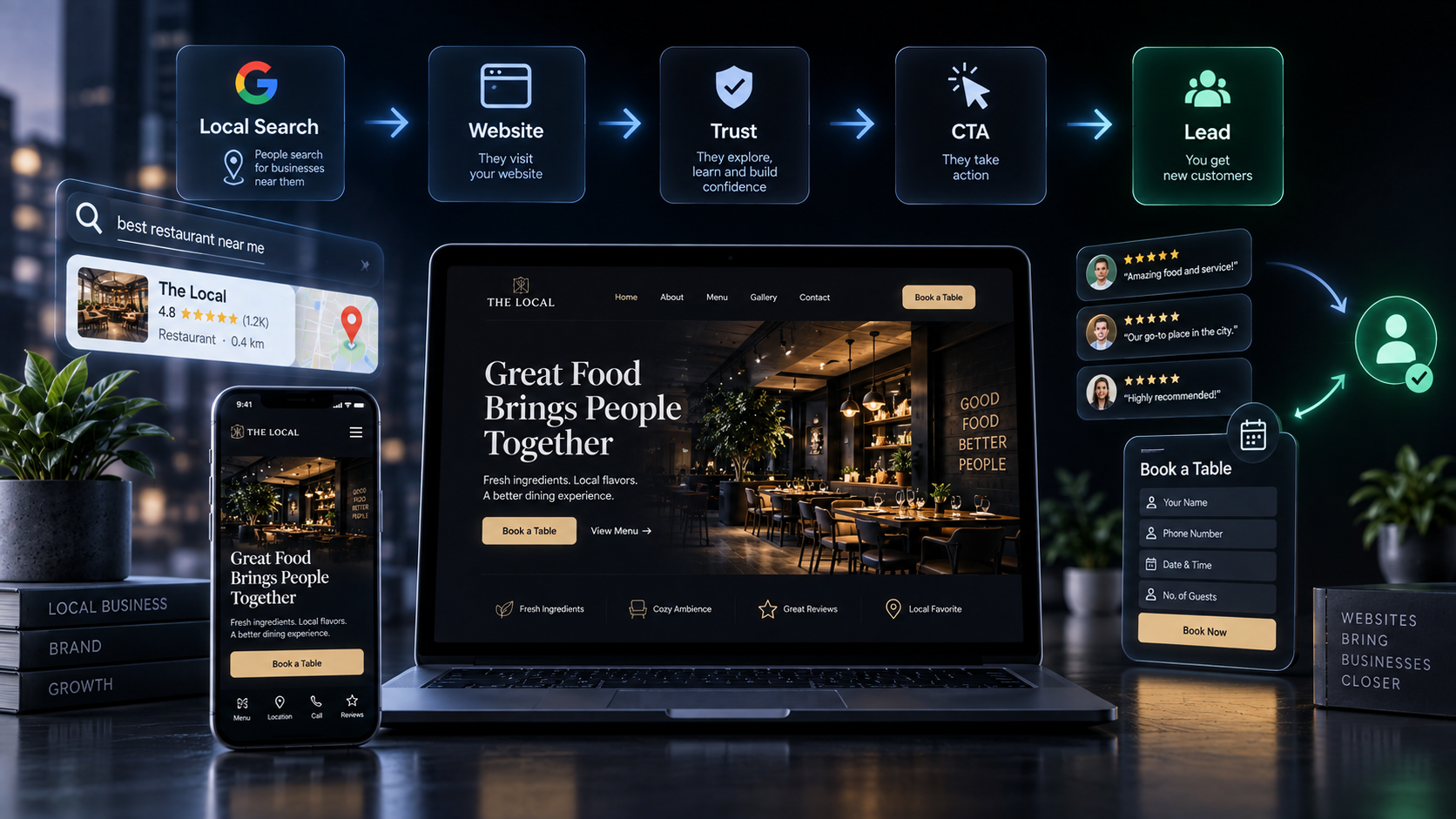
Don't Forget Local Search
For businesses serving specific locations, search visibility isn't only about global rankings.
People search for businesses by location, service, and context.
For example:
“website development agency in Delhi”
or:
“best website designer near me”
Local visibility can involve:
Accurate business information
Location-specific pages where genuinely useful
Relevant local content
Consistent business details
Reviews
Local relevance
Clear service areas
AI-powered discovery can also make contextual information increasingly important.
If your business serves a specific market, make that context clear.
AI Search Doesn't Mean “Rank #1 in ChatGPT”
Be careful with claims like:
“We can guarantee that your business will rank #1 in ChatGPT.”
AI-powered search and recommendation systems don't work like a single traditional search-results page.
Visibility can depend on the query, context, sources, model behaviour, available information, and other factors.
Measurement and attribution are also still developing.
So businesses should be skeptical of anyone selling certainty where the system itself is dynamic.
A more useful objective is:
Make the business easier to discover, understand, cite, recommend, and evaluate across relevant search experiences.
That is a much stronger long-term strategy.
What Businesses Should Actually Do
You don't need to rebuild your entire SEO strategy overnight.
Start with the fundamentals.
01 — Clarify Your Positioning
Make it obvious:
Who you help → What you help them achieve → How you help → Why you
Your website should not leave search engines, AI systems, or humans guessing about your business.
02 — Map Your Search Intent
Identify the questions your audience asks at different stages.
Awareness
“What is...?”
Consideration
“Which is better...?”
Evaluation
“How much does...?”
Decision
“Who provides...?”
Create useful content for each stage.
03 — Strengthen Your Website Architecture
Review:
Navigation
URLs
Headings
Internal links
Service pages
Content hierarchy
Indexability
Mobile experience
Your website should make sense as a system.
04 — Create High-Value Content
Prioritize:
Experience over generic summaries.
Original insight over repetition.
Useful answers over keyword stuffing.
Evidence over unsupported claims.
Case studies, original research, first-party data, and practical expertise can make content much harder to replace with generic AI-generated material.
05 — Improve Entity Clarity
Clearly communicate:
Business name
Services
Locations
Industries
Expertise
People
Products
Relationships between these entities
Make the business understandable as a coherent entity.
06 — Add Appropriate Technical Foundations
Review:
Metadata
Semantic structure
Performance
Mobile usability
Structured data
Sitemap
Indexing
Internal linking
Technical accessibility
Don't treat technical SEO as a separate project from the website.
07 — Measure More Than Rankings
Rankings matter.
But they are not the entire outcome.
Track:
Organic traffic
Search queries
Relevant landing pages
Engagement
Leads
Conversion rate
Lead quality
Revenue where measurable
AI/search visibility signals where available
The ultimate question remains:
Did search visibility create business value?
The New Search Visibility Stack
A useful way to think about modern search is as a stack:
Technical Foundation
↓
Content & Search Intent
↓
Entity Clarity
↓
Authority & Evidence
↓
User Experience
↓
Traditional Search Visibility
↓
AI Search Visibility
↓
Business Outcomes
Notice what isn't at the top:
“AI hacks.”
Because AI search visibility is not a replacement for fundamentals.
It sits on top of them.
What This Means for Your Content Strategy
The future doesn't belong simply to businesses that publish the most.
It belongs to businesses that become genuinely useful sources of information in their category.
That means your content should increasingly answer:
What does our audience need to know?
What decisions are they trying to make?
What mistakes are they trying to avoid?
What information do competitors fail to explain?
What do we know from real experience?
What evidence can we provide?
What unique perspective can we contribute?
This creates content that has a reason to exist.
And that matters whether the reader discovers it through Google, an AI assistant, social media, a referral, or directly through your website.
SEO Is Becoming More About Being the Best Answer
The old mindset was:
“How do we rank?”
The stronger mindset is:
“How do we become the most useful result for the right question?”
Those two approaches overlap.
But they lead to very different behaviour.
The first can produce keyword-heavy content designed around algorithms.
The second encourages businesses to understand their audience, create genuinely useful resources, demonstrate expertise, build authority, and make their information easy to understand.
That's a much stronger foundation.
How BrandVerseHQ Thinks About Search
At BrandVerseHQ, we don't see SEO as an isolated service that sits beside a website.
We see search visibility as part of a broader digital growth system:
Business Strategy
→
Website
→
Content
→
SEO
→
AI Search Visibility
→
Conversion
→
Analytics
→
Optimization
AI Search Visibility should strengthen the broader system rather than become a disconnected promise.
The opportunity isn't to chase every new search acronym.
It's to build a digital presence that is:
Technically accessible.
Clearly structured.
Useful to people.
Understandable to machines.
Supported by evidence.
Connected to measurable business outcomes.
That is a more durable strategy than trying to reverse-engineer every change in an algorithm.
The Future of SEO Is Not Less Human
If anything, it raises the value of genuine human expertise.
AI can summarize what already exists.
Businesses still need to contribute something worth discovering.
That might be:
Experience
Original research
Strong opinions backed by reasoning
Customer insights
Proprietary data
Case studies
Real-world examples
Better explanations
New frameworks
The question isn't:
“How much content can AI help us create?”
It is:
“What can we create that generic content cannot easily replace?”
That is where the long-term advantage lies.
A Practical SEO + AI Search Checklist
Before publishing your next important page or article, ask:
Audience
Who is this for?
What problem are they trying to solve?
Intent
What are they actually looking for?
Does the content satisfy that intent?
Clarity
Is the subject immediately understandable?
Is the business context clear?
Value
Does this teach, explain, compare, or help someone decide something useful?
Evidence
What makes the information credible?
Can we support important claims?
Structure
Is the page easy to scan?
Are related topics connected?
Technical Foundation
Is the page accessible and indexable?
Are the important technical elements in place?
Search
Is there a clear primary search topic?
Are related questions addressed naturally?
AI Search
Is the information easy to interpret?
Is the business/entity context clear?
Does the content provide useful, answer-oriented information?
Business
What action should the reader take next?
How will we know whether this content created value?
The final question matters most.
Search visibility without business value is just another vanity metric.
Frequently Asked Questions
Is SEO dead because of AI search?
No. Search is evolving, but people still use search engines and other discovery systems to find information, businesses, products, and solutions. The opportunity is expanding from traditional rankings toward broader search and AI visibility.
What is AI Search Visibility?
AI Search Visibility refers to making a business, its information, expertise, and content easier for AI-powered search and recommendation experiences to discover, understand, and potentially surface in relevant responses.
Is AI Search Visibility the same as SEO?
They overlap but are not identical. Traditional SEO focuses heavily on search-engine discoverability and visibility, while AI Search Visibility considers how information may be understood and surfaced within AI-powered experiences as well.
Should businesses stop focusing on Google SEO?
No. Traditional search remains important. A stronger strategy is to build solid SEO foundations while also preparing content, structure, entity information, and authority for emerging AI-powered discovery.
Can AI-generated content rank in Google?
The important question is not whether AI was involved in producing the content. What matters is whether the resulting content is useful, relevant, trustworthy, and valuable to the audience. Businesses should avoid creating large volumes of generic content simply to target keywords.
How do I optimize my website for AI search?
Start with fundamentals: clear business information, strong technical accessibility, logical architecture, useful content, search intent alignment, entity clarity, appropriate structured data, authority, evidence, and a strong user experience.
Can someone guarantee that my business will appear in ChatGPT or another AI search engine?
Be cautious with guarantees. AI-powered search and recommendation systems are dynamic, and visibility can depend on context, queries, sources, models, and other factors. Measurement and attribution are still developing.
What should I measure for SEO in the AI-search era?
Measure traditional search visibility and business outcomes alongside emerging visibility signals where reliable measurement is available. Useful metrics can include relevant organic traffic, search queries, engagement, conversions, lead quality, and revenue.
Final Thought
SEO isn't disappearing.
The definition of being discoverable is getting broader.
Google still matters.
Search intent still matters.
Technical foundations still matter.
Content still matters.
Authority still matters.
But businesses now have another question to consider:
Can our digital presence be understood and discovered when people search through AI-powered experiences too?
The answer won't come from one hack.
It will come from building a stronger system.
Clear business positioning.
Useful content.
Strong technical foundations.
Search intent.
Entity clarity.
Authority and evidence.
Excellent user experience.
Measurement and continuous improvement.
The future of search isn't simply about ranking for more keywords.
It's about becoming easier to discover, understand, trust, and choose.
And that is a much bigger opportunity than SEO alone.