For years, digital visibility had a relatively simple scoreboard.
Where do you rank on Google?
If your business appeared near the top of the search results for an important query, you had a good chance of being discovered.
SEO became the discipline built around that goal.
But the way people discover businesses is expanding.
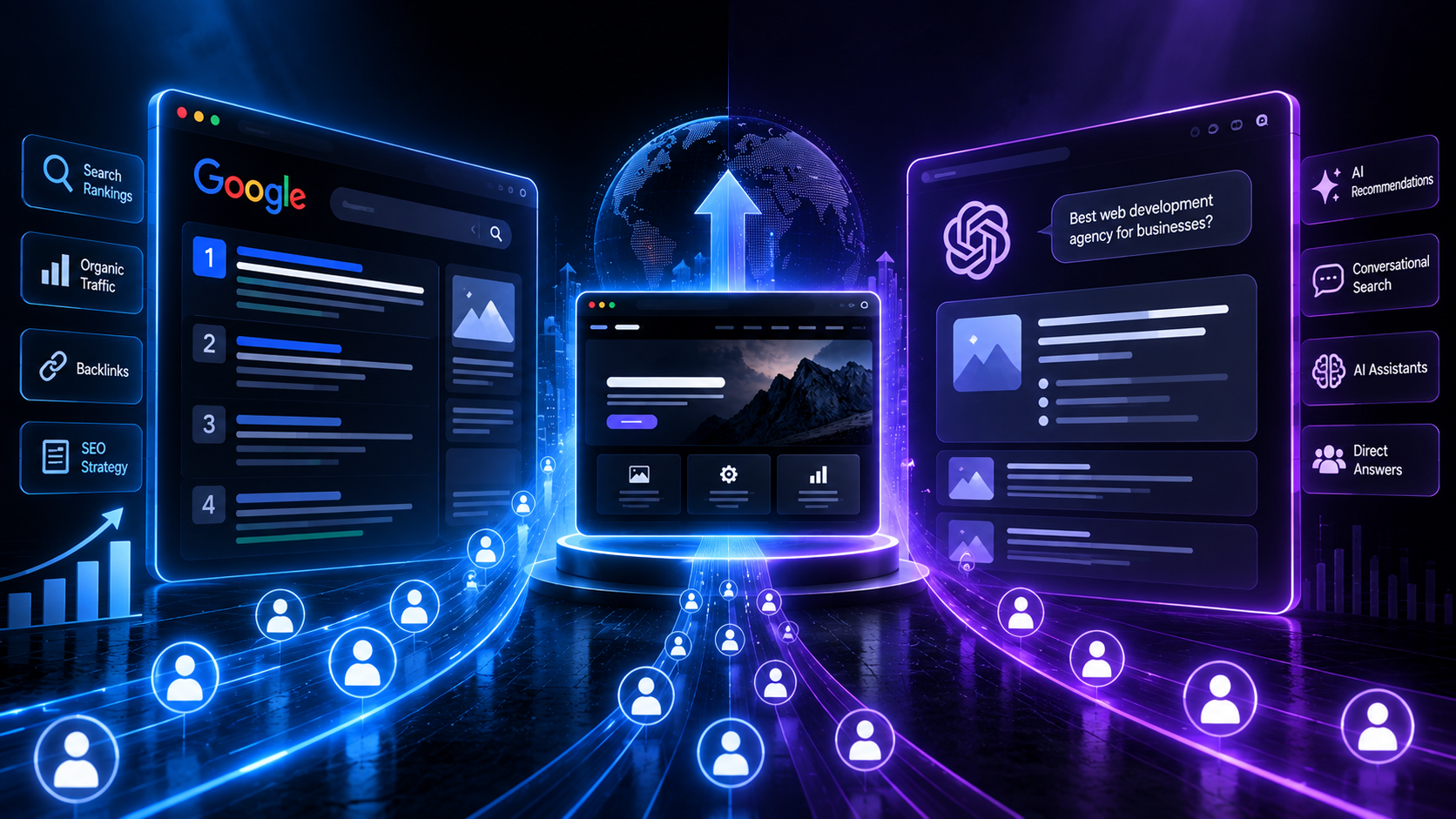
Someone might still search Google and compare traditional results.
They might also ask an AI-powered search experience:
“What are the best website development agencies for a growing business?”
Or:
“Which website platform makes sense for a professional services company?”
Or:
“Who should I consider for redesigning an outdated business website?”
The user isn't necessarily looking for ten links anymore.
They may be looking for an answer, a shortlist, a comparison, or a recommendation.
That creates a new challenge for businesses:
It's no longer enough to be visible. Your business needs to be understandable and credible enough to be considered.
The battle for brand visibility is expanding.
From Ranking for a Query to Being Chosen for an Answer
Traditional search often looks like:
Query → Results → Ranking → Click
AI-powered discovery can introduce another layer:
Question → Interpretation → Sources → Answer → Recommendation → Decision
That changes the nature of visibility.
A business can have strong traditional search visibility and still be poorly represented when someone asks a more complex, conversational question.
Why?
Because ranking and recommendation involve different kinds of signals and experiences.
A search result can tell someone:
“Here is a page that may be relevant.”
A recommendation-style experience can effectively say:
“Here are some options worth considering.”
That second step introduces a much stronger connection between visibility and trust.
The New Search Journey
Imagine a potential customer is looking for a website development partner.
The old journey might be:
Search Google
↓
Open several websites
↓
Compare them
↓
Choose one
The emerging journey can be more conversational:
Describe the problem
↓
Receive an AI-generated explanation
↓
Ask for recommendations
↓
Compare options
↓
Investigate the suggested businesses
↓
Visit selected websites
↓
Make a decision
The website still matters.
SEO still matters.
But the discovery layer between the question and the website can become much more important.
Your brand may be evaluated before someone ever visits your homepage.
Google Rankings Still Matter
This isn't a story about Google becoming irrelevant.
Traditional search remains an important source of discovery.
Businesses still need strong foundations:
Search-friendly architecture
Useful content
Relevant keywords and topics
Internal linking
Crawlability
Indexability
Good performance
Mobile usability
Clear metadata
Meaningful search intent alignment
Even BVHQ's current website and project foundations treat page titles, meta descriptions, headings, search-friendly URLs, sitemaps, indexing, semantic structure, mobile implementation, Analytics, and Search Console as important parts of search visibility.
The point is not to replace traditional SEO.
It's to build beyond it.
The Visibility Stack Is Getting Bigger
Think of brand visibility as layers.
Layer 01 — Discovery
Can people find you?
Layer 02 — Understanding
Can they quickly understand what you do?
Layer 03 — Relevance
Does your business actually match their problem?
Layer 04 — Trust
Is there enough evidence to believe you?
Layer 05 — Authority
Do credible signals support your expertise?
Layer 06 — Recommendation
Could your business become one of the options surfaced when someone asks for help?
Layer 07 — Conversion
Once discovered, can the person take the next step?
This is why AI Search Visibility should not be treated as an isolated trick.
It sits on top of the broader digital foundation.
AI Doesn't Just Need Content. It Needs Context.
One of the biggest differences between traditional keyword optimization and modern AI discovery is context.
A keyword can tell a system what a page mentions.
Context helps explain what the page actually represents.
Consider a company website.
It should make clear:
Who is the company?
What does it offer?
Who does it serve?
Where does it operate?
What does it specialize in?
What evidence supports its expertise?
What other relevant entities, services, people, or organizations is it connected to?
This is where entity clarity becomes increasingly important.
Your business shouldn't look like a random collection of pages.
It should form a coherent digital identity.
Business → Services → Expertise → Audience → Location → Evidence
The clearer those relationships are, the easier it becomes for systems to understand the business.
Being Mentioned Isn't the Same as Being Recommended
This distinction matters.
Imagine an AI system mentions your company because your website contains the words “website development.”
That is basic visibility.
Now imagine a potential customer asks:
“Which agencies would you recommend for a high-performance website for a growing professional services business?”
For your business to become a meaningful candidate, simply mentioning website development isn't enough.
The surrounding information matters.
The system needs enough context to understand:
What you specialize in
Who you serve
What you are known for
Whether your experience is relevant
Whether credible evidence supports your positioning
Visibility gets you into the conversation. Relevance and trust help you stay there.
Authority Becomes Even More Important
AI-generated answers can compress a large amount of information into a short response.
That makes source quality important.
Businesses should therefore think beyond:
“How many articles have we published?”
and toward:
“Why should our information be trusted?”
Useful authority signals can include:
Original research
First-party data
Case studies
Demonstrated expertise
Expert contributions
Client experience
Reviews
Industry recognition
Useful resources
Consistent, accurate business information
Generic content is easy to reproduce.
Real experience is harder to manufacture.
That is one reason BVHQ's content strategy emphasizes original research, interviews, case studies, unique data, first-party insights, and practical expertise rather than relying on generic AI-generated articles as a long-term moat.
The more interchangeable your content is, the harder it is to build meaningful authority from it.
Your Content Needs to Answer Real Questions
The future of search is increasingly conversational.
That means businesses should understand the questions their audiences actually ask.
Not only:
“What keyword should we target?”
But:
“What decision is this person trying to make?”
For a website development company, that might mean creating useful resources around:
Custom website vs WordPress
Website redesign decisions
Website pricing
Website performance
Lead generation
SEO foundations
Conversion optimization
Website architecture
AI search visibility
Local search
These topics can attract different stages of the customer journey.
Some people are learning.
Some are comparing.
Some are evaluating providers.
Some are ready to act.
Good search content meets people at the question they're actually trying to answer.
Write Answers, Not Keyword Containers
A page designed primarily around keyword repetition can feel unnatural.
A page designed around a genuine question can become much more useful.
Instead of creating a page because:
“We need an article targeting this keyword.”
start with:
“What would a genuinely useful answer to this question look like?”
Then make that answer:
Clear
Structured
Specific
Complete
Evidence-based
Easy to understand
Relevant to the intended audience
SEO still has a role.
Keywords still provide useful signals.
But the content should serve the reader first.
Search optimization should strengthen usefulness, not replace it.
Technical Foundations Still Matter
AI search doesn't eliminate technical SEO.
Your information still needs to be accessible.
Your website still needs to communicate its structure.
Your important pages still need to be discoverable.
Technical foundations can include:
Logical information architecture
Search-friendly URLs
Semantic structure
Internal linking
Mobile-friendly implementation
Performance optimization
Indexability
Appropriate structured data
Clear metadata
XML sitemaps
These are not “old SEO.”
They are part of making digital information usable by systems.
Good technical foundations make good information easier to discover and interpret.
Structured Data Is Context, Not a Magic Trick
Structured data can help describe what a page represents.
Depending on the page, that might involve information about:
An organization
A product
A service
An article
A local business
An event
Other supported entities
But structured data should not be treated as an AI-search cheat code.
Adding markup to a page doesn't automatically make a business authoritative.
The foundation still matters:
Useful information + clear structure + credible evidence + technically accessible implementation
Structured data is one part of that system.
Not the system itself.
Local Businesses Have Another Opportunity
AI-powered discovery can make context particularly important for local businesses.
People don't always ask:
“What is the best restaurant?”
They may ask:
“Where can I find a good restaurant near me?”
Or:
“Which clinic should I consider for this service?”
Or:
“Who are the best website agencies in Delhi for a small business?”
Location, service, audience, reputation, and context can all matter.
That makes local digital presence more than simply having an address on a Contact page.
Businesses should make their relevant geographic and service context clear across their digital presence.
Your Website Is Still the Source of Truth
AI discovery may happen somewhere else.
But eventually, many people will want to investigate the business themselves.
They will visit the website.
And then the familiar questions return:
Does this business look credible?
Can I understand what they offer?
Can I see evidence?
Does the website feel trustworthy?
Can I find the information I need?
Can I contact them easily?
This is why search visibility and website experience cannot be treated as separate disciplines.
You can win the discovery moment and lose the website visit.
Getting recommended is only valuable if the experience validates the recommendation.
The New Brand Visibility Loop
A stronger model looks like this:
Search / AI Discovery
↓
Brand Visibility
↓
Website / Content
↓
Understanding
↓
Trust
↓
Engagement
↓
Conversion
↓
Measurement
↓
Improvement
The loop continues.
A business learns what questions people ask.
It creates better resources.
It improves its website.
It strengthens authority.
It improves conversion.
It measures results.
Then it repeats.
Visibility becomes an ongoing system rather than a one-time ranking project.
Don't Chase Every AI Search Acronym
The industry has accumulated plenty of terminology:
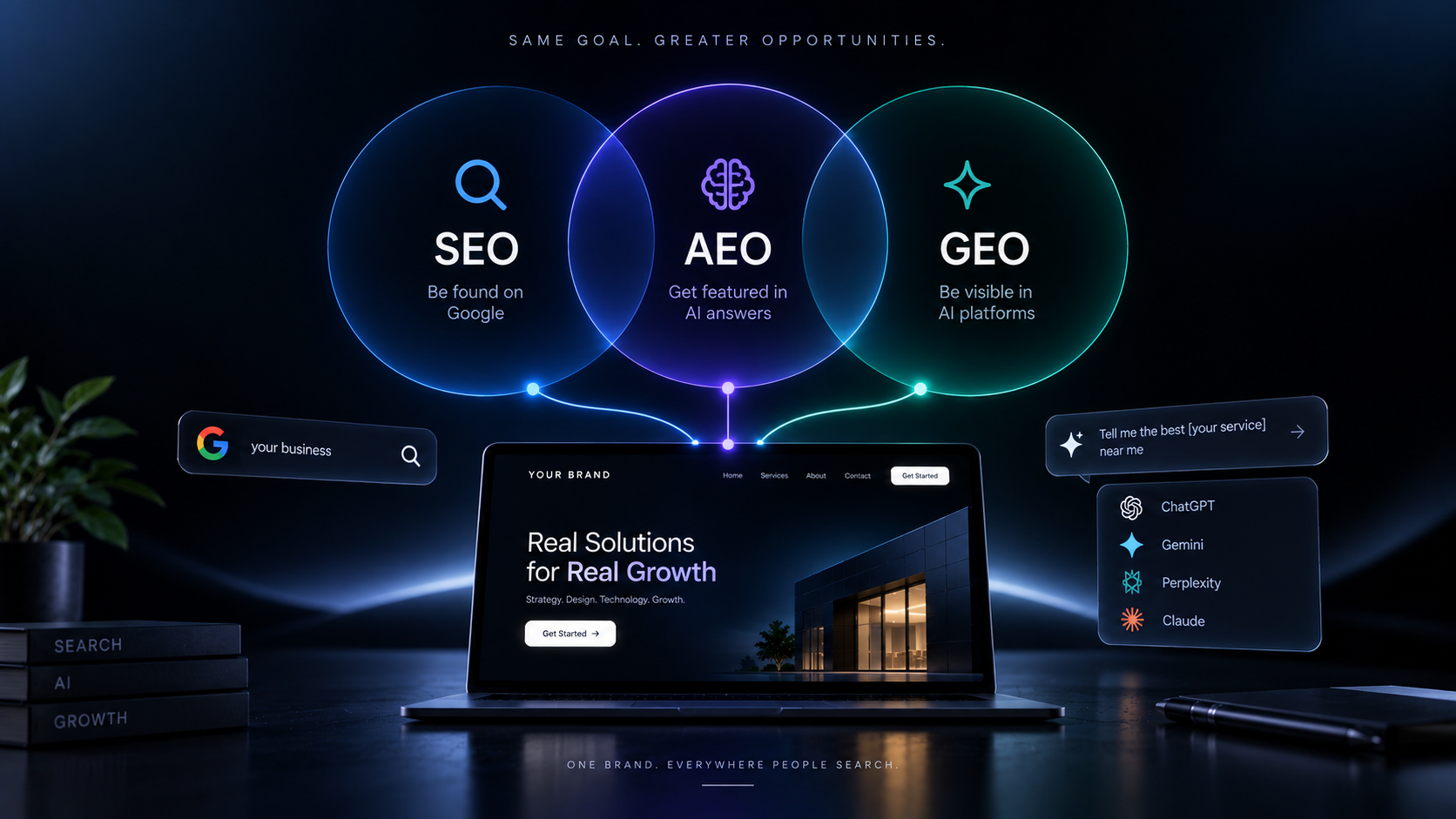
SEO
AEO
GEO
AI SEO
AI Search Optimization
LLM Optimization
Some of these concepts overlap.
The terminology will continue evolving.
Your strategy shouldn't depend on which acronym becomes fashionable next.
Instead, focus on the durable fundamentals:
Be discoverable.
Be understandable.
Be useful.
Be credible.
Be relevant.
Be technically accessible.
Provide evidence.
Measure what matters.
Those principles will remain valuable even as interfaces and algorithms change.
Don't Promise “#1 in AI”
This is another area where businesses should be careful.
Traditional search already involves many variables.
AI-powered recommendations add more complexity.
The response can depend on:
The question being asked
Context
Available sources
The system being used
How information is interpreted
Model behaviour
Geographic or user context
Timing
That makes claims such as:
“We'll get your business ranked #1 in ChatGPT.”
far too simplistic.
A more meaningful objective is:
Build a digital presence that is easier for relevant search and AI systems to discover, understand, evaluate, and potentially surface.
The source strategy for BVHQ explicitly cautions against promising “#1 in ChatGPT” because AI visibility measurement and attribution are still developing.
Build visibility. Don't sell certainty you can't control.
What Businesses Should Do Now
You don't need to throw away your existing SEO strategy.
Strengthen it.
01 — Make Your Business Easy to Understand
Clearly communicate:
Business identity
Services
Products
Audience
Locations
Industries
Expertise
Differentiators
Don't make people or systems infer basic facts.
02 — Build Around Search Intent
Map the questions your audience asks.
Then create resources that help them:
Learn → Compare → Evaluate → Decide
03 — Strengthen Your Website Architecture
Review:
Navigation
URLs
Internal links
Headings
Content hierarchy
Indexability
Mobile experience
Technical performance
04 — Create Original Evidence
Don't rely entirely on generic summaries.
Add:
Case studies
First-party insights
Original research
Data
Examples
Expert perspectives
Lessons from real projects
Experience creates differentiation.
05 — Build Entity Clarity
Make relationships clear:
Company → People → Services → Industries → Locations → Expertise → Evidence
Your digital presence should communicate one coherent identity.
06 — Strengthen Your Authority
Earn credibility through useful work and credible references.
Don't think only in terms of publishing.
Think:
What would make someone comfortable recommending us?
07 — Make the Website Worth Visiting
If someone discovers you through Google or an AI recommendation, the website should confirm that the recommendation makes sense.
Improve:
Messaging
UX
Performance
Trust
Service pages
Conversion paths
Content
Discovery creates opportunity. Experience creates confidence.
08 — Measure the Business Outcome
Traditional SEO metrics still matter:
Impressions
Clicks
CTR
Average position
Organic traffic
BVHQ's own Search Console intelligence is designed around metrics such as organic clicks, impressions, CTR, average position, and identifying opportunities such as ranking and CTR improvements.
But don't stop there.
Also consider:
Qualified enquiries
Conversion rate
Lead quality
Revenue
Assisted conversions
Search-driven business value
And as AI visibility measurement matures, incorporate reliable signals where they become available.
Visibility is useful. Business impact is the goal.
A Practical AI Search Readiness Checklist
Ask these questions about your business.
Identity
Is our business clearly described?
Is our positioning consistent?
Services
Are our core services easy to understand?
Do individual services have useful supporting information?
Audience
Is it clear who we serve?
Location
Is our relevant geographic context clear?
Content
Are we answering the real questions our audience asks?
Authority
Do we have evidence supporting our expertise?
Structure
Can people and systems navigate our information logically?
Technical Foundation
Are important pages accessible, indexable, and well structured?
Experience
Does the website validate the expectations created by search?
Conversion
Is the next step obvious?
Measurement
Can we connect visibility to meaningful business outcomes?
If several answers are “not really,” the opportunity isn't necessarily another SEO trick.
It's a stronger digital foundation.
The Battle Is Moving Up the Funnel
Traditional SEO often focused heavily on:
Visibility → Click
The emerging environment increasingly introduces:
Visibility → Interpretation → Consideration → Recommendation → Click → Decision
That means brand matters more.
Positioning matters more.
Authority matters more.
Content quality matters more.
Entity clarity matters more.
And the relationship between your website and your broader digital presence becomes more important.
The question is no longer simply:
“Can people find us?”
It is becoming:
“When people ask for a solution like ours, are we one of the businesses they can discover, understand, trust, and consider?”
That's a much bigger question.
How BrandVerseHQ Thinks About AI Search Visibility
At BrandVerseHQ, AI Search Visibility isn't treated as a standalone promise or a collection of hacks.
It belongs inside a broader digital growth system.
Brand
↓
Website
↓
Search
↓
Content
↓
Visibility
↓
Trust
↓
Conversion
↓
Analytics
↓
Optimization
This aligns with BVHQ's broader approach: business objectives first, relevant attention over raw traffic, continuous improvement over “launch and leave,” and connected digital systems instead of isolated services.
The objective isn't to chase every change in AI.
It is to build digital assets that become more useful and more valuable over time.
Technology changes. Strong fundamentals compound.
What Happens Next?
The companies that benefit from the changing search landscape won't necessarily be the ones with the biggest SEO budgets.
They'll be the ones that understand what their audiences need and build digital experiences around those needs.
They will:
Answer real questions.
Demonstrate real expertise.
Create useful content.
Build clear digital identities.
Earn trust.
Maintain strong technical foundations.
Connect visibility to conversion.
Measure and improve.
That is harder than publishing a few hundred keyword-focused articles.
But it is also much harder to replace.
Frequently Asked Questions
Is Google SEO becoming less important because of AI search?
Not necessarily. Google remains an important discovery channel. The bigger change is that businesses now need to think about visibility across multiple search and discovery experiences rather than relying on traditional rankings alone.
What is AI Search Visibility?
AI Search Visibility is the broader effort to make a business, its information, expertise, and content easier for AI-powered search and recommendation experiences to discover, understand, and potentially surface for relevant questions.
Is AI Search Visibility the same as GEO?
The terminology varies across the industry. Rather than focusing on a single acronym, a durable strategy should emphasize technical accessibility, entity clarity, useful content, authority, evidence, search intent, and measurement.
Can a business guarantee being recommended by AI?
No responsible strategy should promise guaranteed AI recommendations or a fixed position in an AI-generated response. AI systems can produce different results based on queries, context, sources, models, and other factors.
Do I still need traditional SEO?
Yes. Technical SEO, search intent, content, architecture, performance, and discoverability remain important foundations for digital visibility.
How can I make my business easier for AI systems to understand?
Start with clarity. Make your business identity, services, audience, locations, expertise, and supporting evidence clear across your website and broader digital presence. Organize information logically and use appropriate technical structures.
Does publishing more content improve AI search visibility?
Not automatically. More content can help when it answers useful questions and strengthens topical coverage, but generic or repetitive content is unlikely to create a durable advantage. Original expertise, evidence, research, and useful insights are more valuable.
Should I optimize my website specifically for AI?
Don't build an entirely separate website for AI. Strengthen the fundamentals that benefit both people and search systems: clear information, useful content, good structure, technical accessibility, performance, authority, and a strong user experience.
Final Thought
For years, the question was:
“How high do we rank on Google?”
That question still matters.
But it is no longer the only question.
The next question is:
“When someone asks for a business like ours, can we become one of the names worth considering?”
That requires more than rankings.
It requires relevance.
Clarity.
Authority.
Evidence.
Useful content.
A strong website.
A coherent digital identity.
The future of search isn't simply a battle for blue links.
It is increasingly a battle for attention, understanding, trust, and recommendation.
And the businesses that prepare for that shift won't just be easier to find.
They'll be easier to choose.