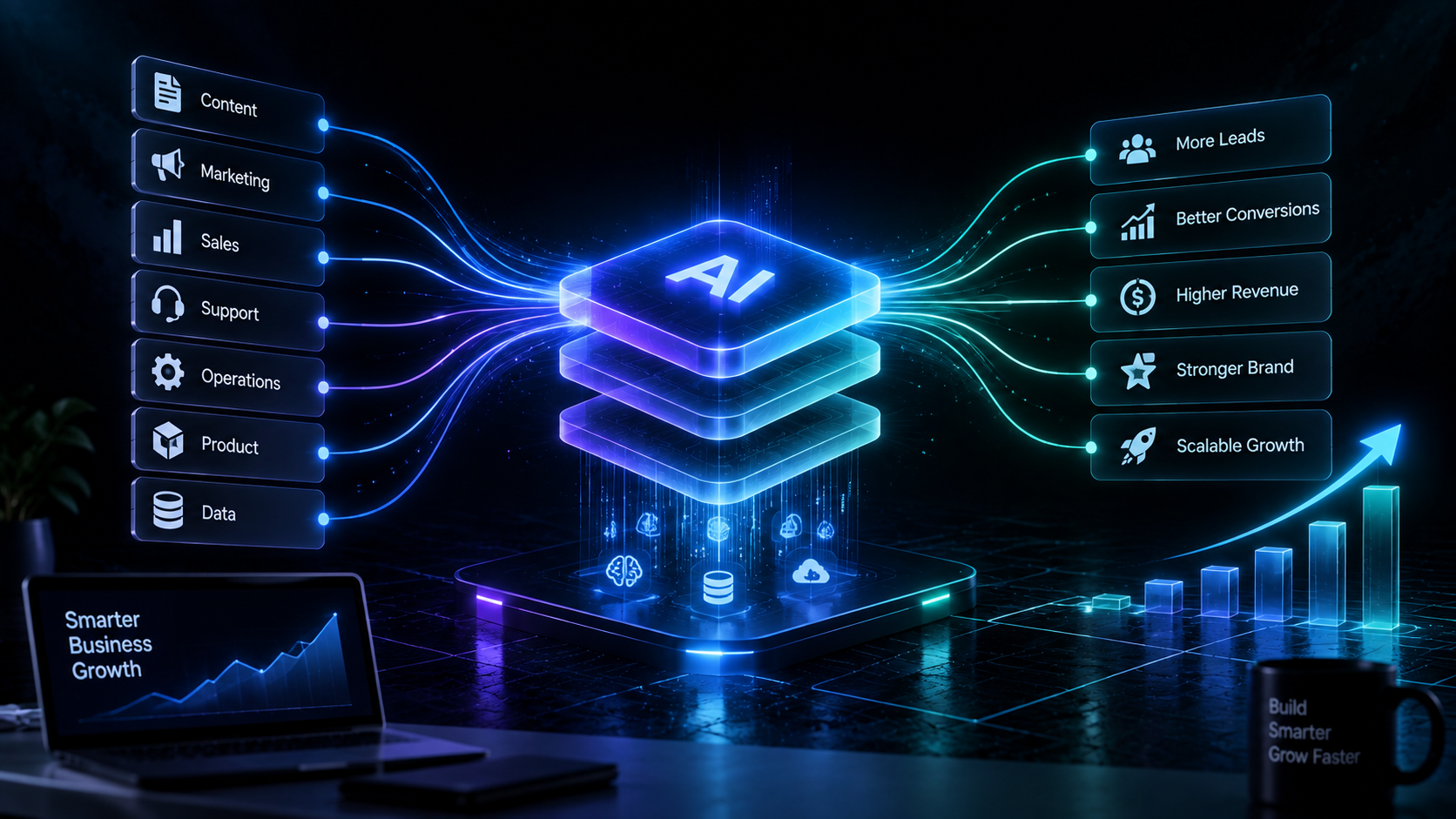
AI is moving beyond chatbots and content generation. For businesses, the bigger opportunity is using AI across the systems that attract customers, improve experiences, automate work, and turn data into better decisions.
Artificial intelligence is often introduced as a tool.
Write this email.
Create this image.
Summarize this document.
Generate this code.
Answer this question.
But that view is becoming too narrow.
The more important shift is not that businesses have access to better AI tools. It is that AI is increasingly becoming a layer that can sit across the business itself.
It can help a company understand customers, qualify leads, personalize experiences, analyze performance, automate repetitive processes, support employees, improve marketing, accelerate development, and turn scattered information into actionable decisions.
That changes the question businesses should be asking.
Not:
“Which AI tool should we use?”
But:
“Where can intelligence improve the way our business grows and operates?”
That is the difference between adopting AI as a productivity tool and building an AI-enabled growth system.
The Shift: From AI Tool to AI Layer
A tool usually solves a specific task.
An AI layer can influence multiple parts of a system.
Consider a typical digital business journey:
Marketing → Website → Visitor → Lead → CRM → Follow-up → Customer → Retention → Analytics
AI can potentially contribute at every stage.
Business area | Traditional approach | AI-enabled approach |
|---|---|---|
Content | Manual production | Research, drafting, analysis and optimization assistance |
Website | Static experience | Context-aware and increasingly interactive experiences |
Lead generation | Form submission | Qualification and prioritization |
CRM | Database | System that can surface actions and patterns |
Sales | Manual research | AI-assisted research and preparation |
Support | Human-only responses | AI assistance with human escalation |
Marketing | Campaign execution | Analysis, personalization and optimization |
Operations | Rule-based workflows | Intelligent workflows and agents |
Analytics | Reporting what happened | Identifying patterns and possible next actions |
The important point is not that AI should replace every process.
It shouldn't.
The opportunity is to identify where intelligence creates leverage.
AI Does Not Create Growth by Itself
This distinction matters.
Adding AI to a weak business process does not automatically create a strong business.
If the website has unclear messaging, AI-generated content will not solve the positioning problem.
If the CRM contains poor-quality data, an AI agent may simply make decisions using poor information.
If the sales process is undefined, automation can make the wrong process happen faster.
If the business does not know its objective, AI can generate an enormous amount of activity without producing meaningful progress.
This is why AI should sit inside a business strategy, not replace one.
A useful model is:
Business Objective → Strategy → Process → Data → AI → Action → Measurement → Improvement
AI becomes valuable when it strengthens that chain.
Where AI Can Become a Growth Layer
AI's business value becomes clearer when we stop looking at individual tools and start looking at the customer and business journey.
1. AI Can Strengthen Customer Acquisition
Customer acquisition involves much more than advertising.
Businesses need to understand:
Who is the ideal customer?
What problem are they trying to solve?
Where do they search?
What questions do they ask?
What makes them trust a company?
What causes them to take action?
AI can assist with research, audience analysis, content exploration, campaign analysis, competitor research and lead qualification.
But the objective isn't to produce more marketing.
It is to create more relevant marketing.
That distinction is important.
More content is not necessarily more visibility.
More traffic is not necessarily more opportunity.
More leads are not necessarily more revenue.
The system should ultimately connect activity to business outcomes.
2. AI Can Make the Website More Than a Digital Brochure
For many businesses, the website is still treated as a collection of pages.
Home.
About.
Services.
Contact.
But a modern website can become a much more important part of the growth system.
It can:
explain the business
answer common questions
guide visitors
capture leads
qualify enquiries
personalize journeys
connect with CRM systems
surface relevant information
support sales
collect behavioral signals
connect marketing activity with conversion data
AI can add another layer to that experience.
Imagine a potential customer arriving with a very specific problem.
Instead of forcing them to navigate through five pages to find the right information, an intelligent experience could help them understand:
What is relevant to them → What solution fits → What they should do next
That does not mean every website needs an AI chatbot.
Sometimes the best AI experience is invisible.
It might simply improve search, recommendations, personalization, content discovery, lead routing or internal decision-making.
3. AI Can Turn a CRM Into a System of Action
Traditional CRM systems primarily store information.
A modern AI-enabled CRM can increasingly help interpret that information.
Consider a sales pipeline containing 500 leads.
A human salesperson could manually review:
lead status
last contact
previous conversations
company information
source
engagement
next follow-up
deal value
AI can assist in identifying patterns and prioritizing what deserves attention.
For example:
Lead A
High-value opportunity → recently engaged → follow-up overdue
Lead B
Low engagement → several unsuccessful follow-ups → lower priority
Lead C
Strong fit → proposal viewed → likely requires immediate attention
The important transformation is:
CRM → Intelligence → Recommended Action
That is much more valuable than simply adding an AI chat window to the CRM.
4. AI Can Improve Sales Without Replacing Salespeople
Sales is another area where AI can create leverage.
Before a sales conversation, AI can assist with:
company research
industry research
prospect context
conversation preparation
objection analysis
meeting summaries
proposal preparation
follow-up drafting
opportunity prioritization
But the salesperson still owns the relationship.
This creates an important principle:
AI should reduce low-value work so humans can spend more time on high-value decisions and relationships.
The goal is not necessarily fewer people.
The goal can be more capacity per person.
5. AI Can Become an Operations Layer
This may ultimately become one of the most important applications.
Businesses contain countless repetitive processes.
A lead arrives.
Someone qualifies it.
Someone enters it into the CRM.
Someone assigns it.
Someone sends an email.
Someone schedules a follow-up.
Someone prepares a report.
Someone checks whether something is overdue.
Someone updates a spreadsheet.
Some of these processes can be automated.
Others can become AI-assisted.
The emerging model is:
Trigger → Context → AI Decision → Action → Human Escalation → Measurement
This is particularly useful when the process has clear boundaries.
For example:
A new lead arrives → collect relevant information → evaluate fit → assign a score → create CRM record → recommend next action → escalate unusual cases to a human.
That is more powerful than simply asking an AI system to “manage leads.”
But there is an important requirement:
Governance
Not every AI decision should automatically trigger a business action.
High-impact decisions may require:
AI recommendation → Human review → Approved action
That creates a safer operating model than giving an AI system unrestricted authority.
6. AI Can Connect Data That Businesses Usually Keep Separate
One of the biggest problems inside growing businesses is fragmentation.
Marketing has one set of information.
Sales has another.
The website has analytics.
The CRM contains leads.
Customer support has conversations.
Finance has revenue data.
Management has reports.
AI becomes much more valuable when these systems can work together within appropriate permissions and governance.
The goal is not simply:
“We have lots of data.”
The goal is:
“We can turn our data into better decisions.”
For example:
Traffic → Lead → Sales Opportunity → Customer → Revenue
Now marketing performance can be evaluated against something more meaningful than clicks.
A business can begin asking:
Which channels create qualified opportunities?
Which types of leads convert?
Which pages influence enquiries?
Where are prospects dropping out?
Which customers are most valuable?
Where should sales spend more time?
That is where AI starts moving from productivity into business intelligence.
AI + Automation Is More Powerful Than AI Alone
AI and automation are often discussed separately.
They become much more interesting together.
Automation is good at predictable actions.
AI is useful when interpretation or judgment is required.
For example:
Automation:
When a form is submitted, create a CRM record.
AI + Automation:
When a form is submitted, analyze the enquiry, identify the likely service requirement, estimate lead quality based on predefined criteria, summarize the opportunity, create the CRM record, recommend the next action, and escalate uncertain cases.
The second system introduces intelligence into the workflow.
But there is an important requirement:
Governance
AI systems should operate within clearly defined permissions, rules and escalation paths.
The New Business Stack
A traditional digital growth stack might look like:
Website → SEO → Marketing → Leads → CRM → Sales
An AI-enabled growth architecture can become:
Brand → Website → Search → Marketing → Leads → CRM → Automation → AI → Analytics → Optimization
The advantage is not simply having more technology.
The advantage is connection.
A website should support marketing.
Marketing should generate relevant attention.
Relevant attention should become opportunities.
Opportunities should enter a useful CRM system.
The CRM should support sales.
Automation should remove repetitive work.
AI should improve interpretation and decision-making.
Analytics should show what is actually happening.
And those insights should improve the next cycle.
AI Should Not Become Your Business Strategy
There is a temptation to respond to the AI shift by becoming an “AI-first” company overnight.
That can create its own problems.
Businesses may start buying:
AI writing tools
AI meeting tools
AI chatbots
AI agents
AI analytics platforms
AI design tools
AI coding tools
Suddenly there are dozens of tools.
But no clear system.
More AI does not automatically mean more growth.
The better question for every AI initiative is:
What business problem does this solve?
Then:
What metric should improve if it works?
For example:
AI initiative | Business objective | Possible metric |
|---|---|---|
AI lead qualification | Improve sales efficiency | Qualified-lead rate |
AI content assistance | Increase useful content output | Production time + organic performance |
AI support assistant | Reduce repetitive support work | Resolution time |
AI sales research | Improve preparation | Research time |
AI reporting | Improve decision speed | Reporting time |
AI workflow automation | Reduce manual work | Hours saved |
AI personalization | Improve conversion | Conversion rate |
This prevents AI from becoming another source of vanity metrics.
The Real Competitive Advantage Is Not “Using AI”
AI tools are increasingly accessible.
That means simply saying:
“We use AI.”
is unlikely to be a meaningful long-term differentiator.
The stronger advantage comes from knowing:
where AI should be used
where it should not be used
what data it needs
what processes it should connect to
where humans should remain involved
how its performance should be measured
how the system should improve over time
In other words:
AI capability is becoming easier to access.
AI implementation judgment becomes more valuable.
As AI makes raw execution faster, differentiation moves toward strategy, UX, engineering, conversion, SEO, automation, measurement and proprietary systems rather than simply having access to the latest model.
Build the Moat Around Your Business, Not Your AI Vendor
A business should be careful about treating a particular AI model or platform as its competitive advantage.
Models will change.
Tools will change.
Pricing will change.
Capabilities will change.
Your business knowledge is harder to replace.
That knowledge can include:
proprietary workflows
customer insights
industry knowledge
internal benchmarks
case studies
operational data
lead-scoring frameworks
automation logic
design systems
SOPs
decision frameworks
first-party research
For BVHQ, this principle is particularly important.
The long-term moat should not be one AI model, one framework, or one software platform.
It should be the intellectual property and systems built around them.
A Practical Framework for Adding AI to Your Business
You do not need to transform the entire company at once.
Start with the business.
Step 1: Identify Repetitive Work
List processes that consume significant time.
Examples:
research
reporting
data entry
lead qualification
content preparation
customer support
meeting notes
follow-ups
internal documentation
Step 2: Identify Decision Bottlenecks
Ask where people spend time interpreting information.
Examples:
Which lead should we contact first?
Which campaign is performing poorly?
Which customers need attention?
Which opportunities are worth pursuing?
Which operational problems keep repeating?
These can be strong candidates for AI assistance.
Step 3: Map the Data
Before introducing AI, determine what information it needs.
Ask:
Where does the data live?
Is it accurate?
Is it structured?
Who can access it?
What information is sensitive?
How frequently does it change?
Poor data can undermine an otherwise sophisticated AI workflow.
Step 4: Define the Human Boundary
Decide what AI can:
Suggest
versus what it can:
Execute
versus what requires:
Human approval
This becomes increasingly important as AI systems move from generating information toward taking actions.
Step 5: Connect the Workflow
Instead of adding an isolated AI tool, connect it to the actual process.
For example:
Website → Lead Form → AI Qualification → CRM → Follow-up → Sales → Revenue
Now AI has a role inside a business system.
Step 6: Measure the Outcome
Track:
AI Cost → Time Saved → Quality → Rework → Business Result
This is a more useful framework than simply measuring how many AI-generated outputs were produced.
The objective is not maximum AI usage.
The objective is better business performance.
What Businesses Should Do Now
A practical starting point for most businesses is not “deploy 20 AI agents.”
It is much simpler.
1. Strengthen the Digital Foundation
Make sure the website, analytics, CRM and core processes are reliable.
2. Document Important Workflows
You cannot intelligently automate a process you do not understand.
3. Clean Your Data
AI systems are only as useful as the context available to them.
4. Start With High-Leverage Problems
Choose processes where improvement has a measurable business impact.
5. Keep Humans in the Loop Where Judgment Matters
Automation should not eliminate accountability.
6. Build Reusable Systems
Don't create one-off AI experiments that cannot scale.
7. Keep Measuring
Every AI workflow should have a reason to exist and a way to evaluate whether it is working.
The Bigger Shift: From Digital Presence to Digital Intelligence
The first phase of digital transformation was about getting online.
Businesses built websites.
Then came digital marketing.
Businesses learned to attract traffic and generate leads.
Then came analytics.
Businesses started measuring what happened.
Now another layer is emerging.
Intelligence.
The question is increasingly becoming:
Can your digital systems not only collect information and perform actions, but also help your business understand what to do next?
That is where AI becomes much more interesting.
It can sit between:
Information → Interpretation → Decision → Action → Learning
And that creates the possibility of a continuously improving digital growth system.
AI Is Not the Destination
The mistake would be to make AI the objective.
AI is not the business outcome.
Revenue is.
Efficiency is.
Customer experience is.
Better decisions are.
Faster execution is.
Higher-quality work is.
Better conversion is.
Stronger retention is.
Sustainable growth is.
AI is infrastructure that can help support those outcomes.
The businesses that benefit most may not necessarily be the ones using the most AI.
They may be the ones that understand where intelligence creates the most leverage.
The BVHQ Perspective
At BrandVerseHQ, we see digital growth as a connected system rather than a collection of disconnected services.
Strategy → Website → Visibility → Attention → Trust → Action → Growth
AI can increasingly become another layer across that system.
Not as decoration.
Not as a buzzword.
Not simply as a chatbot.
But as an intelligence layer that can support research, marketing, websites, lead intelligence, CRM, automation, analytics, optimization and future digital products.
The broader direction becomes:
Brand → Website → Search → Marketing → Leads → CRM → Automation → AI → Analytics → Optimization
That is a more useful way to think about the future of digital growth.
Key Takeaways
AI is moving beyond individual productivity tools.
Its bigger opportunity is becoming a layer across business systems.
AI should support business strategy, not replace it.
Websites, marketing, CRM, sales and operations can all become AI-assisted.
AI + automation can create intelligent workflows.
Good data and clear processes become increasingly important.
Human oversight remains essential for important decisions.
“We use AI” is not a durable competitive advantage.
Proprietary data, workflows, frameworks and business knowledge can become stronger moats.
Every AI initiative should connect to a measurable business objective.
The future isn't about adding AI to everything.
It is about knowing where intelligence can create leverage.
And that is a much bigger opportunity.
Frequently Asked Questions
Is AI replacing traditional business software?
Not necessarily. In many cases, AI is being added as an intelligence layer on top of existing systems. The underlying CRM, analytics, website, databases and workflows can remain important while AI helps interpret information or assist with actions.
Does every business need AI agents?
No. Businesses should first identify a meaningful problem or workflow. An AI agent is useful when its ability to interpret information and take defined actions creates measurable value.
Should businesses automate everything?
No. Some decisions require human judgment, accountability, creativity or relationship-building. The goal is to automate appropriate work, not eliminate human involvement indiscriminately.
Is an AI chatbot enough to make a business AI-powered?
Usually not. A chatbot can be useful, but AI's business value can extend much further into research, sales, CRM, operations, analytics, personalization, automation and decision support.
What should a business do before implementing AI?
Start with clear objectives, well-defined processes, usable data and measurable KPIs. Then identify the workflows where AI can create the most leverage.
What is the biggest AI mistake businesses can make?
Adopting AI because everyone else is doing it without defining the business problem it is supposed to solve.
Final Thought
AI is becoming easier to access.
That makes the technology itself less interesting.
The more important question is what a business builds around it.
A company with a collection of AI tools has technology.
A company with connected data, intelligent workflows, human oversight, measurable outcomes and continuously improving systems has something much more valuable:
an AI-enabled business growth infrastructure.
AI isn't just another tool.
It is becoming a layer through which businesses can understand, operate, improve and grow.
Build. Grow. Evolve.